
Resume af teksten:
Sydkoreas BNP faldt uventet med 0,3% i fjerde kvartal, hvilket delvist skyldes en tilbagegang fra tidligere vækst understøttet af finanspolitiske tiltag. En genopretning forventes i første kvartal, drevet af stærk efterspørgsel efter chips og øget investering. Centralbanken forventes at opretholde en neutral holdning, da vækstudsigterne forbedres. Eksport og investeringer skuffede ved at falde mere end forventet; mens stærke chippriser opvejede fald i bil- og maskineksport. Konstruktion forventes at komme sig efter langvarig nedgang, med øgede byggeordrer og færdig projektfinansiering. For 2026 gættes en BNP-vækst på 2,0%, op fra 1,0% i 2025, med støtte fra øget privatforbrug og positive velfærdstiltag. Svag won og boligregler kan dog dæmpe optimisme. Bank of Korea forbliver sandsynligvis neutral og vil muligvis revidere vækstskøn for 2026, da genopretningen forventes ujævn.
Fra ING:
South Korean GDP unexpectedly contracted 0.3% quarter on quarter in the October-December period, partly due to a technical payback from fiscally supported growth. A first-quarter rebound is expected amid strong chip demand and recovering investment. The Bank of Korea is likely to maintain a neutral stance as growth prospects improve
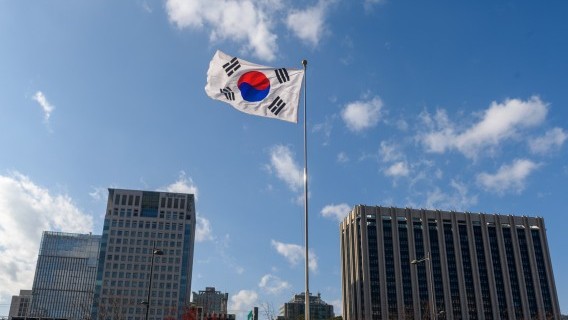
Government Complex, Seoul. Greater political stability should help to anchor South Korea’s recovery in 2026
4Q25 GDP (%QoQ, sa)
2025 GDP growth 1.0% YoY
Downside surprise came from the contraction of exports and investment
We previously projected fourth-quarter South Korean GDP growth to slow to 0.4% quarter-on-quarter, seasonally adjusted, as fiscal stimulus waned even as strong chip exports likely supported overall export growth. Today’s data showed that the economy contracted instead. The slowdown in consumption growth was in line with our expectations. But declines in investment and exports diverged from our estimates. Weak GDP exports likely indicate that robust chip exports are driven by higher prices while auto and machinery exports in real terms dropped due to tariffs and weak global demand. For investment, transportation equipment investment declined sharply, partially offset by IT investment growth.
GDP growth by expenditure

Source: CEIC
GDP is expected to rebound in 1Q26
Although the 4Q25 growth was weaker than expected, we are keeping our 2026 GDP growth unchanged at 2.0% year on year. Stronger-than-expected chip demand is likely to boost exports and facility investment. After five years of contraction, the construction sector is expected to enter a cyclical recovery. Forward-looking construction orders data have rebounded since last year, and much of the project-finance restructuring has been completed. Private consumption should increase moderately. While a significant rise in domestic equities, expanded welfare programmes, and improved consumer sentiment are likely to be supportive factors, stringent housing regulations and a weak Korean won may temper overall optimism.
GDP is expected to grow 2.0% YoY in 2026 compared to 1.0% in 2025

Source: CEIC and ING estimates
BoK watch
The weaker-than-expected 4Q25 GDP outcome is not likely to affect the Bank of Korea’s near-term rate trajectory. Most temporary policy influences are subsiding, and the underlying growth trend is showing signs of recovery. We expect the BoK to revise its 2026 GDP forecast from 1.8% YoY to 2.0% when it updates its projections in February. The recovery is likely to be uneven, and the BoK is still concerned about financial instability. As such, the BoK will keep its current neutral tone for an extended period.
Hurtige nyheder er stadig i beta-fasen, og fejl kan derfor forekomme.