
Resume af teksten:
Efter Davos faldt risikoen for geopolitiske spændinger og tariff-forhøjelser, hvilket gav dollaren mere støtte. USA’s præsident Trump undgik nye EU-tariffer, hvilket styrkede dollaren, mens fokus nu flyttes til den makroøkonomiske situation. Det kommende Fed-møde kan påvirke dollaren yderligere. Jobtal og inflationstal i USA ses som vigtige indikatorer for dollerens styrke. I Europa påvirker USD-bevægelser fortsat EUR/USD, mens Norges Bank forventes at holde den nuværende pengepolitik. I Antipodernes region har AUD og NZD styrket sig, delvis på grund af stabile økonomiske udsigter og gode arbejdsløshedstal. For New Zealand kan stigende inflation understøtte NZD. Tyrkiets centralbank forventes at sænke renten yderligere, med TRY som en attraktiv carry trade takket være stabilt høje valutareserver.
Fra ING:
Davos brought a de-escalation in geopolitical and tariff risk, and the dollar can enjoy a bit more support from here, in our view, as focus shifts to a supportive macro picture. Elsewhere, Norway’s central bank should not surprise markets today, while New Zealand inflation may well outpace the RBNZ’s projections and help NZD, especially in the crosses
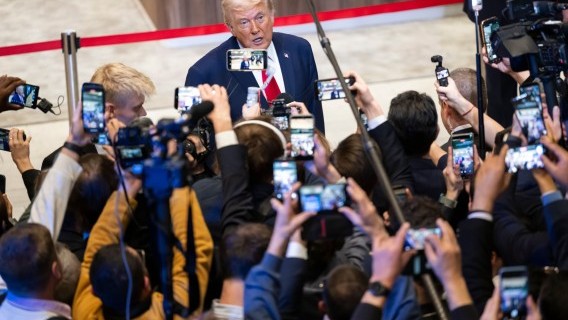
US President Donald Trump speaks with journalists after delivering his speech at the World Economic Forum in Davos

USD: Room to strengthen into FOMC
The dollar has followed the relief rally in risk assets after a framework deal on Greenland prompted Trump to scrap new tariffs on the EU. Trump is handing over negotiations to other top officials, including JD Vance and Marco Rubio.
So far, very little is known about the agreement. Markets may require learning more about that and perhaps a few days of additional conciliatory remarks to finally turn their focus away from Greenland. But the approaching Fed meeting (28 January) means some refocus on macro drivers is on the cards. The combination of stabilising unemployment and the DoJ probe on Powell may be tilting the balance more on the hawkish side.
We discussed last week how Powell’s fierce response to the criminal investigation signalled upside risks to the dollar, as he and other members could have turned more hawkish in a meeting without any rate change to reinforce the independence message.
Some downside risks for the dollar persist: more volatility in JGBs spilling into Treasuries, scrutiny on upcoming US tech earnings, reignition in geopolitical/tariff risk. But the macro picture should favour a bit more dollar strength in the coming days, in our view.
On the data side, jobless claims will be watched closely today after dipping below 200k last week. Core PCE inflation for November is also due today: we expect it to be a modest 0.2% MoM, confirming evidence of muted price pressures from the CPI report. Improved jobs figures have, however, had a much bigger weight on pricing, and we doubt this will trigger any dovish repricing. Finally, we expect November personal income and spending at 0.4% and 0.5% MoM, respectively, in line with the consensus.
Francesco Pesole

EUR: Still USD driven, no surprises in Norway
EUR/USD has slipped back below 1.170 in line with our call. The pair continues to be almost entirely driven by USD moves and the unwinding of tariff risk on the back of a framework Greenland deal, which is proving enough to revive some dollar bulls. As discussed above, the USD downside risks haven’t all disappeared, but further abating of geopolitical tariff risk can favour another gentle leg lower in EUR/USD.
We still see risks extending to 1.1600 in the short term for EUR/USD. Today appears to be a better opportunity for a move lower in the pair than tomorrow, when eurozone PMIs are released and can fit the narrative of an improved eurozone macro outlook.
In the rest of Europe, Norway’s central bank announces policy this morning. We don’t expect any major surprises. The December inflation report showed another small rebound in both headline (3.2%) and core (3.1%). We still think the second matters the most for Norges Bank, and that any dovish turn remains contingent on a decline below 3.0%.
The Bank may well stick to its projection for only one cut this year for this meeting, underpinning NOK’s good performance since the start of the year. We continue to see more upside for NOK over the short term and overvalued SEK in the coming weeks. EUR/NOK could test 11.50 soon.
Francesco Pesole

Antipodeans: Clearing the data tests
AUD and NZD have been the biggest gainers in G10 since the start of January. Their isolation from rising geopolitical risk and stable fiscal prospects relative to other major economies has raised their attractiveness significantly of late.
Domestic inputs also helped AUD overnight. Unemployment surprisingly dipped to 4.1% as employment jumped by 65k, heavily driven by full-time hiring. The result has been a 12bp jump in the two-year AUD swap rate – with markets now pricing in 15bp of tightening already in February and 34bp by June. This seems premature to us, as 4Q trimmed CPI might actually come in a bit below the RBA projections next week. We are therefore a bit wary of chasing AUD/USD much further just yet – also given our relatively bullish short-term USD view. AUD should keep doing fine in the crosses.
In New Zealand, CPI data for 4Q is released tonight. Expectations are for a 3.0% YoY unchanged headline print, and while our model does suggest some downside risks, we must admit that consensus has had a strong track record for this specific release in the past couple of years. That would be 0.3% above the RBNZ projection and a hawkish signal. As usual, non-tradable inflation remains closely watched too and is expected to rise 0.5% QoQ vs the central bank’s 0.4% projection.
A consensus print should keep hawkish speculation in the NZD swap curve alive and NZD supported. Similar to AUD, we prefer NZD in the crosses rather than versus USD in the near term.
Francesco Pesole
TRY: Continuation of the cutting cycle but also carry trade
Given the CBT’s easing bias, lower than expected December CPI driven by non-food items and reserves at all-time highs, we expect a 150bp cut to 36.5% in today’s MPC meeting. However, risks are on the downside towards a lower 100bp adjustment as early indicators point to strengthening pricing pressures in the food group this month and recent data signal a recovery in domestic demand. Market pricing has stabilised at around 150bp for today’s meeting.
Although the 150bp move is priced in, it could be a signal to the market that the CBT is still open to this rate cut pace for the next few meetings. We expect a 27% rate for the end of the year, while the market is pricing in around 30.25-30.50%. This leaves room for more aggressive pricing at the front of the curve for us, but the market would need to see a clearer signal from the central bank or another downward surprise in inflation.
The Turkish lira remains a largely unchanged story, and we enter this year with the same positive carry view. We believe that the combination of a market resistant to political headlines, a slow but steady cutting cycle and record high FX reserves are ideal for the continuation of the current FX regime. Therefore, we believe that TRY will remain the main carry trade in the EM space. That the market has the same view is also indicated by the increasing long positioning in TRY, which has grown to around USD50bn according to our estimates and surpassed the levels from the March peak before last year’s sell-off.
Frantisek Taborsky
Hurtige nyheder er stadig i beta-fasen, og fejl kan derfor forekomme.