
Resume af teksten:
Tysklands Ifo-indeks for januar forbliver uændret på 87,6, hvilket afspejler usikkerheder i økonomien grundet geopolitiske spændinger og trusler om toldsatser. Selvom vurderingen af den nuværende situation er forbedret, er forventningerne svækket. På trods af dette forventes en økonomisk opsving. Industridata viser positive tegn med stigende ordrer, og kommende investeringer i infrastruktur og forsvar kan stimulere økonomien. Dog står Tyskland over for strukturelle udfordringer, som kræver reformer fra kansler Friedrich Merz og hans regering. Risikoen for at skifte fra national depression til selvtilfredshed er stadig en bekymring.
Fra ING:
An unchanged Ifo index in January reflects the uncertainty that has hit the German economy again on the back of geopolitical tensions and tariff threats. However, for now, we stick with our view of an upcoming recovery
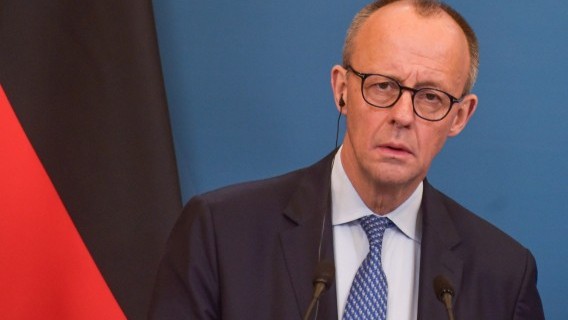
German Chancellor Friedrich Merz
This morning, Germany has literally slid into weather and traffic chaos. While this chaos will only be temporary, the just-released Ifo index suggests that leaving the economic chaos behind will be more cumbersome than seeing today’s snow melt away.
In January, Germany’s leading indicator, the Ifo index, remained unchanged at 87.6. While the current assessment improved somewhat, expectations weakened. The reading should be taken with a pinch of salt, as it is unclear whether most participants sent in their answers before or after US President Donald Trump’s decision not to impose additional tariffs on several European countries.
More generally speaking, the unchanged Ifo index reflects the uncertainty that has hit the German economy again on the back of geopolitical tensions and tariff threats.
Time to get more positive about Germany
Despite this morning’s disappointing Ifo index reading, there are good reasons to be more positive about the German economy. The latest macro data indicates a clear turning point in industry at the end of last year. Industrial orders have now increased for three consecutive months, and even the argument that bulk orders drove the November surge does not really concern us; with the fiscal spending programme, more of these bulk orders will come this year. In fact, bulk orders could be the new normal, not the exception.
While industry is going through a soft and tentative period of cyclical turning, admittedly at still shockingly weak levels, the announced infrastructure and defence investment plans should finally begin to reach the economy this year. Critics often overlook the sluggishness of Germany’s federal decision-making process. It took until late last year for parliament to approve the 2026 budget and almost 30 military procurement contracts.
With the rapid expansion of defence production capacity, there is a good chance that a large part of defence spending will remain within the domestic economy and not leak to other countries. We see a clearly higher multiplier for defence investments than anticipated a year ago. Last but not least, even though corporates never tire of complaining about elevated energy costs, the government’s decision to bring those costs down to one-third of their current levels should bring further relief, if implemented.
Biggest risk: from national depression to national complacency
Even if today’s Ifo index undermines some of our optimism, an economic liftoff is clearly in the making. The Ifo index reading, however, does reflect the uncertainty that has hit the German economy again on the back of geopolitical tensions and tariff threats.
As much as we remain convinced of the upcoming economic recovery, we continue to stress that the economy’s problems are deeply rooted, often structural and largely self-made, except for the China problem. Solving these issues quickly is impossible. This is a completely different challenge from some 20 years ago, when Germany was the ‘sick man of Europe’. Ongoing geopolitical tensions and the everlasting threat and uncertainty regarding US tariffs are further complicating factors for Germany’s economic outlook.
Despite any cyclical upswing, the economy still needs an almost complete makeover, ranging from well-known measures such as reducing red tape and introducing e-government, to mastering and lowering the financial burden of demographics or through tax cuts. It is up to German Chancellor Friedrich Merz and his government to implement these reforms this year and turn a long-awaited rebound into a sustainable recovery.
The too-long period of de facto stagnation seems to be coming to an end. However, the list of potential downside risks is still long. And while there is very little Germany can do to prevent new external shocks, it has full and absolute control over not shifting from one extreme to the other: the biggest domestic risk remains any sudden shift from national depression to national complacency.
Hurtige nyheder er stadig i beta-fasen, og fejl kan derfor forekomme.