

Resume af teksten:
Konflikten mellem USA-Israel og Iran er nu i sin 11. dag, hvilket har påvirket energimarkederne og skabt høj geopolitisk risiko, som målt af GPR-indekset. Der er tre mulige scenarier for konflikten: en hurtig afslutning, hvor olie- og gaspriser stabiliseres hurtigt; en middellangt forløb, hvor priserne forbliver høje; og en længerevarende konflikt, der kan føre til betydelige inflations- og vækstudfordringer, især i eurozonen. Mens USA er bedre rustet som nettoeksportør af energi, kan Europa, især Holland, opleve højere inflation på grund af et stramt arbejdsmarked. Kina kan afbøde nogle virkninger takket være store energireserver. Inflationen globalt forventes at stige, hvilket kan tvinge centralbanker som ECB og Fed til at overveje renteforhøjelser for at undgå inflationsforankring. Situationen forbliver dog usikker, og energipriserne vil spille en central rolle i de økonomiske konsekvenser.
Fra ABN-Amro:
The conflict in between the US-Israel and Iran has entered its 11th day. Geopolitical risk, as measured by the GPR index, has spiked to levels last seen around the Iraq invasion in 2003, and has remained highly elevated since. Since our initial publication last week Monday, it has been a rollercoaster ride for both oil and gas markets [1]. Given the ongoing uncertainty around the duration and impact of the conflict, we have put together three scenarios exploring how the macro-economic impact could evolve over the coming months, focused on the US and eurozone, and with the implications for the ECB and Fed’s key policy rates. We will follow up this note with updates on how we see these scenarios impacting bond and FX markets in the coming days.

Nick Kounis
Chief Economist

Bill Diviney
Head Macro Research / senior economist eurozone
While there are some hints of an early end to the Iran conflict, uncertainty remains high
We map out three scenarios for the conflict and its economic impact
Oil markets could rapidly normalise when the conflict ends, but gas prices are likely to stay higher for longer due to supply tightness
We continue to see inflation being more impacted than growth, and Europe being harder hit than the US in more negative scenarios
Typically a central bank ‘looks through’ energy price shocks…
…but in a more negative scenario we expect the ECB – and possibly the Fed – to hike rates to get ahead of de-anchoring inflation expectations
Inflation in the Netherlands is likely to be more impacted due to the tighter labour market and higher starting point for inflation
China is significantly cushioned by its large energy reserves, but higher inflation could raise the bar for additional ‘piecemeal’ rate cuts
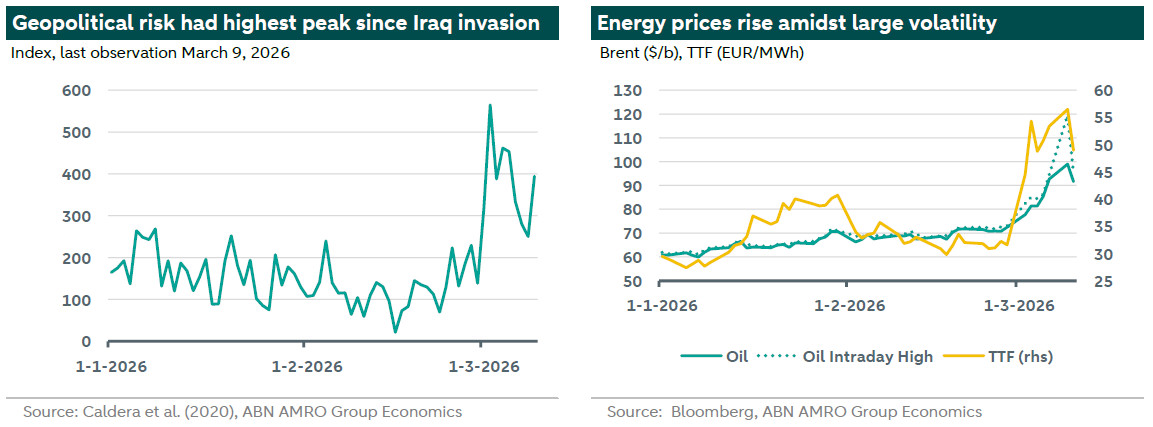
Overnight, US president Trump said that the conflict would be over ‘very soon’ although he responded ‘no’ to the question of whether it would end this week. Energy markets responded positively to his remarks (see right hand chart above), with oil prices plunging back below $100 per barrel and European gas prices falling back below €50 per megawatt hour, down from Monday peaks of almost $120 and €70 respectively. Still, we are by no means out of the woods. Trump’s comments were vague enough to allow the conflict to continue for sometime yet. And it is also unclear if the US retains full control of the situation. Iran’s Parliament Speaker Mohammad Bagher Qalibaf responded by stating it is ‘absolutely’ not seeking a ceasefire, and Iran has continued to launch attacks on infrastructure in neighbouring countries today. It is also unclear if Israel would cease hostilities even if the US were to stop.
Given the still high degrees of uncertainty, in the scenarios below we refrain from giving probabilities, as these are a constantly moving target. Instead, we focus our analysis on describing the various effects the conflict could have, which depend largely on how long the conflict and the corresponding disruptions to energy supplies lasts.
Middle : End to the conflict in the next two months – We start to see a slow resumption of traffic through the Strait of Hormuz in the course of this month and a complete end to the conflict – as a threat to energy supply – within the next two months. Oil prices remain elevated in the near term – averaging $110 per barrel in Q2 – but would start to decline from Q3 onwards. European gas prices would rise to an average of €70 per megawatt hour in Q2, with intraday spikes up to €80, and prices would remain more elevated for longer than for oil prices due to tightness in the gas market (see here and listen here for more).
Negative : Conflict lasts up to a year – Although vessel traffic through the Strait starts to pick up (helped by US, and perhaps European, efforts) it remains well-below normal levels. There is more damage to energy infrastructure. Brent crude prices jump to an average of around $130 per barrel and over Q2-Q3, and on an intraday basis prices could spike as high as $150. European gas prices would jump to an average €120 per megawatt hour by Q4 with intraday spikes up to €180/MWh.
Positive : Conflict ends within weeks – An end to the conflict in the course of this month. The US & Israel may judge that they have met their military objectives and/or some kind of back channel cease fire agreement might be reached. Energy supply would normalise more quickly in this scenario, with oil and gas prices falling back more quickly.
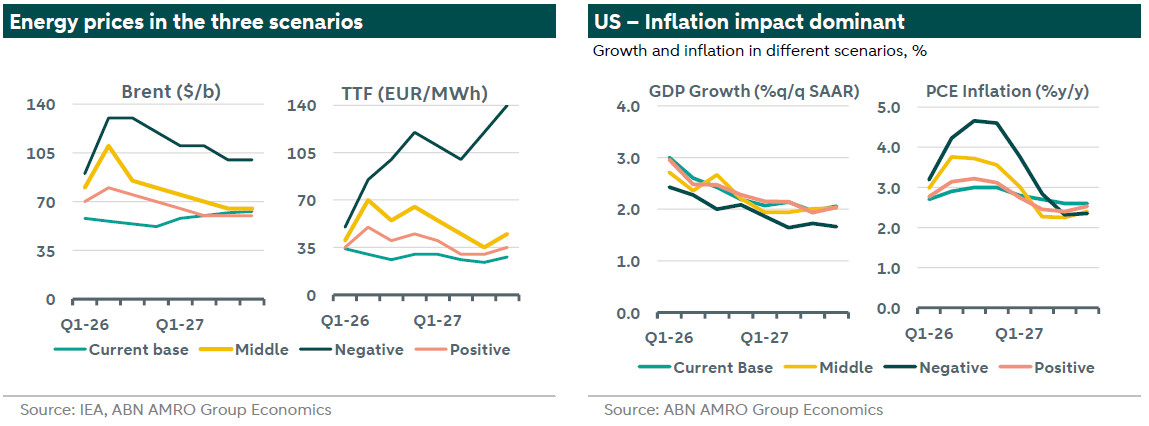
The growth impact of elevated energy prices is quite limited for the US. Over the past decades, the US has become a lot less oil intensive in terms of its GDP, and moreover, the US is actually a net-exporter of energy, such that higher energy prices partly offset any decline in activity. In all but the negative persistent war scenario the GDP impact is therefore effectively negligible. Even in the negative scenario, a substantial part of the decline in activity is not directly attributed to higher energy prices, but rather to uncertainty and more restrictive financial conditions on the back of higher inflation.
The inflation impact is more substantial, particularly given existing price pressures. In our central scenario, energy inflation pushes up the headline rate to nearly four percent by the second quarter of this year. It remains persistently elevated throughout the year, but energy disinflation from high base effects pushes inflation down within reach of the 2% target in the second quarter of 2027. In the negative scenario, we expect inflation to peak at about 4.7% by the third quarter and to remain elevated for substantially longer. There is a significant risk of second round effects beyond the scenario portrayed here, especially in case of inflation de-anchoring and/or excessive fiscal stimulus. There is certainly a scenario where the inflation shock would lead to stimulus checks in the run-up to the mid-term elections, leading to a partial repeat of the perfect storm that led to the post-covid inflation surge. Barring those second round effects, we see inflation coming back in the 2.3-2.7% range by the end of next year in all scenarios, but cumulative inflation is wildly different.
How would the Fed respond? In the middle scenario, inflation rises, but we judge it to stay within the ‘look-through’ range, although this will still prevent them from easing this year. The Fed may gradually resume easing at 25 bps per quarter from Q2-2027 onwards, still reaching our expected terminal rate of 3.00% by the end of 2027. In the negative scenario, inflation rises rapidly. While Powell is still in charge, he’ll try and succeed to get consensus for an initial hike to 4.00%. Once Warsh joins in as chair, the transitory argument will become the dominant narrative, with FOMC members complying at the fear of triggering a substantial equity market downturn by aggressively hiking. Rates will therefore stay at the 4.00% until about the third quarter of 2027. In the positive scenario, we see our current Fed base case of three more cuts at a quarterly pace starting in June still in play.
The impact will depend massively on the duration of the conflict and the hit to energy supplies, with likely nonlinear effects on inflation in particular the longer elevated energy prices persist. Starting with growth, the eurozone is in a weaker position than the US, for two reasons. First, the eurozone is a net importer of energy and so it will not see the same growth boosting offset from higher oil & gas activity that will result from higher prices. Second, households are still only just getting over the trauma of the 2022-23 energy crisis and have remained incredibly cautious – this is reflected in the still high savings rates. A new energy shock is therefore likely to be a setback to the consumer recovery that was just getting underway.
Even so, we do not expect the impact to be as severe as during the energy crisis – when the economy stagnated for 5 quarters – even in the negative scenario outlined above. First, the scale of gas price rises even in the negative scenario is still a fraction of that seen during the height of 2022-23 crisis, when gas prices rose more than 1000%+ from pre-crisis levels. Second, the impact of persistently higher gas prices is likely to have less spillover to electricity prices this time around due to the greater diversification of European energy supplies (including the renewables buildout) in recent years. Indeed, this is already apparent in the reaction of electricity prices so far to the jump in gas prices; even in Germany and the Netherlands, electricity prices have stayed below their January highs. As such, the real income shock to households – and the hit to energy intensive industry – is likely to be much lower this time around. All told, we would expect growth to be somewhat lower than our current base case in the middle scenario, and to slow to well below trend for a time in the negative scenario, with growth likely to pick up again into 2027 assuming some easing in energy prices.
For inflation, the situation could be more worrisome, especially in the negative scenario. In the middle and positive scenarios the jump in inflation is expected to be short-lived and with minimal second round effects. However, in the negative scenario second round effects are likely to be more significant. For instance, higher fertiliser costs are likely to push food inflation higher again, while energy intensive goods and services will likely also see a lift. There is also the risk that this spills over into the labour market, with persistent high inflation spurring workers to bargain for higher wages as they did in 2022-23. This mini ‘wage-price spiral’ could make the inflation wave considerably more persistent.
In the positive scenario we expect the ECB to ‘look through’ the rise in energy inflation as a central bank typically does in such a short-term shock. However, in the middle scenario we think the Governing Council could be worried enough about the risk of second round effects to do an insurance rate hike, likely at the 30 April meeting. In the negative scenario, this would then be followed up by another two rate hikes as the ECB would want to get well ahead of any spillovers to the labour market.
For the Netherlands, the implications broadly mirror those of the eurozone. The impact will depend on how the conflict evolves. Across the central, negative, and positive scenarios, the transmission to the economy is expected to occur more through higher inflation than through a pronounced near‑term growth shock.
Preliminary estimates indicate that the negative scenario would lead to a marked slowdown in Dutch GDP growth relative to our current baseline, with a negative quarter in 2026 plausible. A prolonged recession, as we saw with the four consecutive quarters of contraction in 2022–23, is unlikely even in the negative scenario. In the other scenarios the growth shock is more shallow.
Inflation, by contrast, could see more significant impact. In both the middle and positive scenarios, Dutch inflation may experience increases, surpassing the 3% again, in line with the eurozone. In the negative scenario, inflation is likely to be somewhat stronger than in the euro area for several reasons. First, the starting point of inflation differs: where eurozone inflation is already below the 2% ECB target, Dutch inflation is still elevated at 2.4% as of February. Second, the timing of the energy shock is unfavourable. With CLA-wage growth still above 4%, the Netherlands is in the long tail of the previous energy shock. Combined with a persistently tight labour market, this raises the risk of more pronounced second‑round effects on inflation, compared to the eurozone.
That said, the economy enters this uncertainty from a position of resilience. Recent growth momentum has been robust, and key fundamentals, such as household savings and private debt ratios, have improved.
Being the world’s largest oil and LNG importer, China is vulnerable to disruptions in the production and transport of energy in/from the Middle East, and the related spike in oil and gas prices. China imports 73% of its oil needs, and the share of imports coming from the Middle East is estimated at around 40%, with Saudi Arabia, and Iraq the key suppliers. The total share of China’s oil imports coming from Iran is estimated to be around 10%. As around one-third of oil and around one-quarter of LNG flowing through the Strait of Hormuz is destined for China, Chinese officials have not surprisingly called on ‘all sides’ of the Iran war to immediately ease military operations, avoid a further escalation and ensure the safe passage of ships through the Strait of Hormuz. Regarding US-China relations, the Iran conflict could complicate preparations for a meeting between presidents Trump and Xi scheduled for end March/early April. However, we still think both countries have clear incentives to extend the truce on tariffs/chokepoints. Recent communication by China’s foreign minister also suggests China’s prioritises a (relatively) stable relationship with the US at the moment.
There are also some cushioning factors for China. The country has been stockpiling energy massively when prices were relatively low, and its total oil reserves are estimated at around 80 days of consumption. Its diversified import base also helps, and it looks likely that China can increase oil imports from Russia relatively easy. Moreover, China also has other energy sources at its disposal. The share of electricity created by renewable energy, for instance, has risen sharply over the past few years, to almost 40% in 2025, as China has positioned itself as a global leader in the energy transition. Nevertheless, last week the Chinese government told large oil refiners to suspend the exports of diesel and gasoline in light of the Middle East conflict. Furthermore, while a (sustained) shock in oil and gas prices would undoubtedly be inflationary, China’s starting point in terms of inflation is more favourable levels compared to for instance the US or Europe. Still, a firmer inflation path would probably make the PBoC even more cautious in terms of additional (piecemeal) monetary easing.
In the below table we summarise our scenarios and the key macro and market impacts we expect.
[1] What a prolonged LNG supply shock could mean for gas prices and inflation
Nick Kounis
Chief Economist
Bill Diviney
Head Macro Research / senior economist eurozone
Hurtige nyheder er stadig i beta-fasen, og fejl kan derfor forekomme.