

N News put together this guide to COP 24 to answer some of the biggest questions you may have and make sure you’re all caught up, with a ringside seat on the action.
1. The basics: UNFCCC, UNEP, WMO, IPCC, COP 24, Kyoto Protocol, Paris Agreement… can someone please make sense of all this?

These acronyms and place names all represent international tools and terms that, under the leadership of the UN, were created to help advance climate action globally. They all play a specific and different role in focussing us all on achieving environmental sustainability. Here’s how it fits together:
In 1992, the UN organised a major event in Rio de Janeiro called the Earth Summit, in which the UN Framework Convention on Climate Change (UNFCCC) was adopted.
In this treaty, nations agreed to “stabilize greenhouse gas concentrations in the atmosphere” to prevent dangerous interference from human activity on the climate system. Today, the treaty has 197 signatories. Every year since the treaty entered into force in 1994, a “conference of the parties” – a COP – is held to discuss how to move forward and, since there have been 23 COPs so far, this year’s will be the 24th, or “COP 24”.
Because the UNFCCC had non-binding limits on greenhouse gas emissions for individual countries and no enforcement mechanism, various “extensions” to this treaty were negotiated during these COPs, including: the famous Kyoto Protocol in 1997, which defined emission limits for developed nations to be achieved by 2012; and the Paris Agreement, adopted in 2015, in which all countries of the world agreed to step up efforts to limit global warming to 1.5°C above pre-industrial temperatures and boost climate action financing.
Two agencies support the scientific work of the UN on climate change: the UN Environment Programme (UNEP) and the World Meteorological Organization (WMO). Together, they set up the Intergovernmental Panel on Climate Change (IPCC) in 1988, which is made of hundreds of experts, dedicated to assessing data and providing reliable scientific evidence for the climate action negotiations, including the upcoming ones in Katowice.
2. The UN seems to be having a lot of conferences and summits on this subject… Is any of it, well… fruitful?
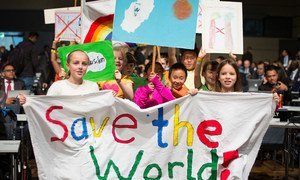
These meetings have been vital to find a global consensus on an issue that requires a global solution. Although progress has been much slower than needed, the process — which has been as challenging as it is ambitious – has worked to bring all countries with very different circumstances, together. Progress has been made every step of the way. Some of the concrete actions taken so far prove one thing: climate action has a real positive impact and can truly help us prevent the worst.
Here are some notable achievements so far:
– At least 57 countries have managed to bring their greenhouse gas emissions down to the levels required to curb global warming.
– There are at least 51 “carbon pricing” initiatives in the works; charging those who emit carbon dioxide per tonne emitted.
– In 2015, 18 high-income countries committed to donating US$100 billion a year for climate action in developing countries. So far, over $70 billion have been mobilised.
3. Why is everyone talking about the Paris Agreement?
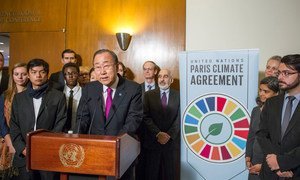
The Paris document – which provides the world with the only viable option for addressing climate change – has been ratified by 184 parties, and entered into force in November 2016.
The commitments contained in it are significant:
– Limit global average temperature rise to well below 2°C and pursue efforts to limit the temperature increase to 1.5°C.
– Ramp up financing for climate action, including the annual $100 billion goal from donor nations for lower-income countries.
– Develop national climate plans by 2020, including their self-determined goals and targets.
– Protect beneficial ecosystems that absorb greenhouse gases, including forests.
– Strengthen resilience and reduce vulnerability to climate change.
– Finalize a work programme to implement the agreement in 2018.
The United States, which joined the Agreement in 2016, announced its intention in July 2017, to withdraw from it. However, the nation remains a party to the Agreement at least until November 2020, which is the earliest that it can legally request to withdraw from it.
READ MORE HERE
https://news.un.org/en/story/2018/11/1026851