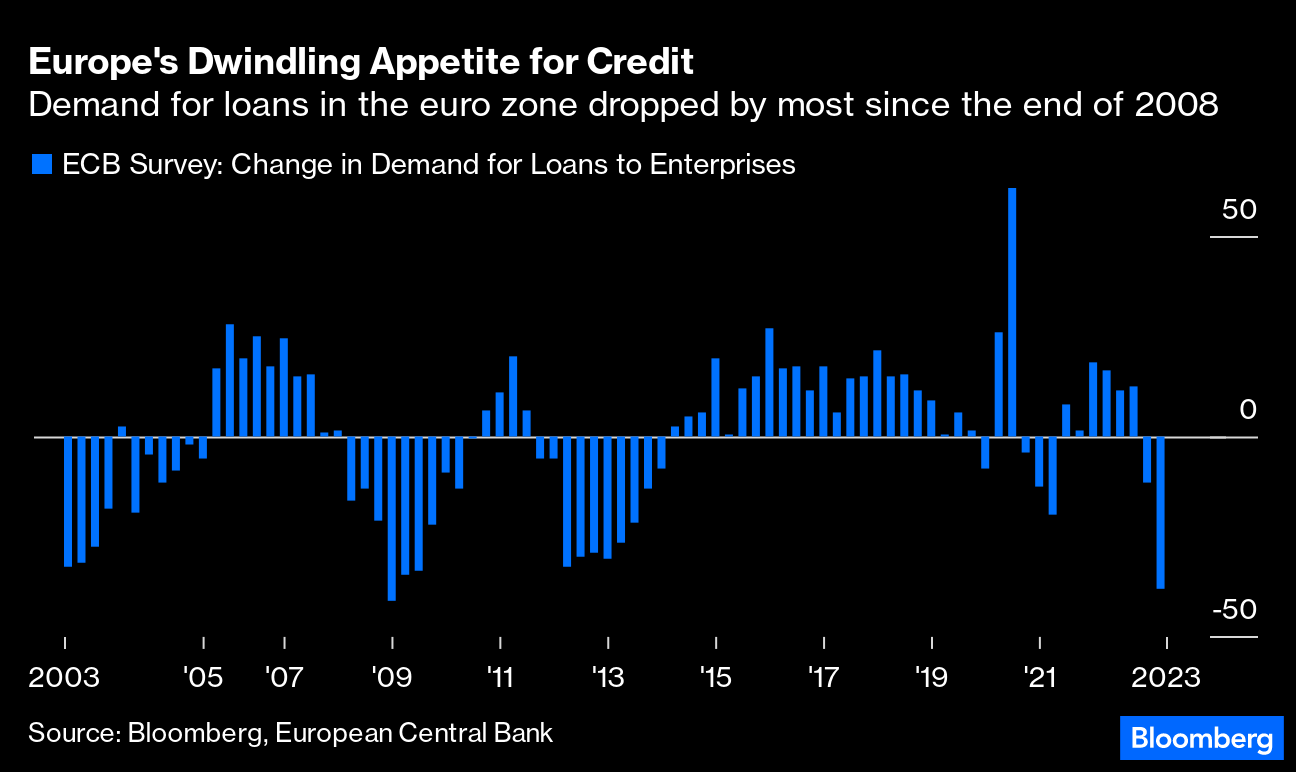
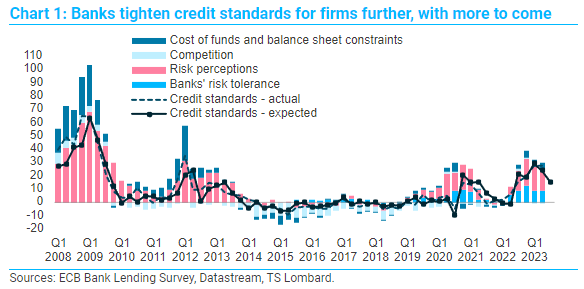
Europe’s banks are making it harder for people to borrow, and its companies are much less keen on taking out loans. Those are the most important takeaways from the European Central Bank’s latest survey of banks’ lending standards, and at this juncture those numbers could scarcely matter more. The disintermediation of finance has not progressed as far in Europe as in the US, and banks — rather than bond markets — still tend to be the most important providers of credit. If the ECB wants to alter financial conditions, it must do so through the lenders. Perhaps the most telling detail concerns demand for credit, rather than banks’ willingness to supply it. A big majority of lending officers are reporting lower interest from the corporate sector; in the survey’s 20 years, the only period that saw a bigger drop in corporate appetite for borrowing was the final quarter of 2008, at the very worst of the Global Financial Crisis: On the other side of the equation, banks are tightening their lending standards. This chart was produced by TS Lombard’s Davide Oneglia: The proportion of banks tightening is comparable with the worst moments of the euro zone’s sovereign debt crisis at the beginning of the last decade, so the ECB should be glad to see that it’s having an effect. Usually, tighter credit translates swiftly into lower inflation. So far, that absolutely isn’t happening, and it’s barely started in the US, where the Federal Reserve’sequivalent senior lending officers’ survey is due at the beginning of next week. This chart is from Jim Reid of Deutsche Bank AG: |