referat af analyser fra Apollo og Morgan Stanley
Analyserne beskriver, hvordan en langvarig krig med Iran gradvist ændrer investorernes syn på inflation, vækst, renter og staters økonomi. Forfatterens hovedpointe er, at jo længere konflikten varer, desto mere bliver markedet tvunget til at indregne, at konsekvenserne ikke blot er midlertidige energiprischok, men kan få varige virkninger for hele den makroøkonomiske udvikling.
I den første fase har markedsreaktionen været ret klassisk: investorer har købt energiaktier og solgt det meste andet. Samtidig er de gået væk fra aktiver, som klarer sig bedst ved faldende renter, og over mod aktiver, der kan drage fordel af højere obligationsrenter. Det afspejler et marked, der først og fremmest har fokuseret på olieprisernes inflationsskabende effekt.
Alligevel peger teksten på et vigtigt paradoks: de langsigtede inflationsforventninger er næsten ikke steget. Tværtimod viser 5Y5Y-inflationsswaps, at markedet forventer lavere inflation på lidt længere sigt end tidligere på året. Det tyder på, at investorerne opfatter energiprishoppen som et kortsigtet chok snarere end begyndelsen på en mere permanent inflationsspiral.
På aktiemarkedet er virksomheder og analytikere ifølge teksten næsten gået i stå. Der kommer omtrent lige så mange opjusteringer som nedjusteringer, og indtjeningsforventningerne til S&P 500-selskaberne er faktisk blevet hævet den seneste måned. Det tolkes som et tegn på, at der endnu ikke er sket en reel forværring i virksomhedernes forventninger. Derfor kan investorer hurtigt vende tilbage til aktier, når usikkerheden dæmper sig, selv om ingen kan sige præcist hvornår.
På rentemarkedet trækker teksten især på analyser fra Apollo og Morgan Stanley. Apollo-økonom Torsten Slok argumenterer for, at de amerikanske 10-årige renter ligger højere, end de “burde”, hvis man alene så på forventningerne til Federal Reserve. Ifølge ham skyldes den ekstra rentepræmie blandt andet bekymringer om amerikansk finanspolitik, mindre udenlandsk efterspørgsel efter statsobligationer, kvantitative stramninger og tvivl om centralbankens uafhængighed. Muligheden for, at Fed i fremtiden hæver sit inflationsmål, nævnes også som en risiko, fordi det kan gøre inflationen mere ustabil.
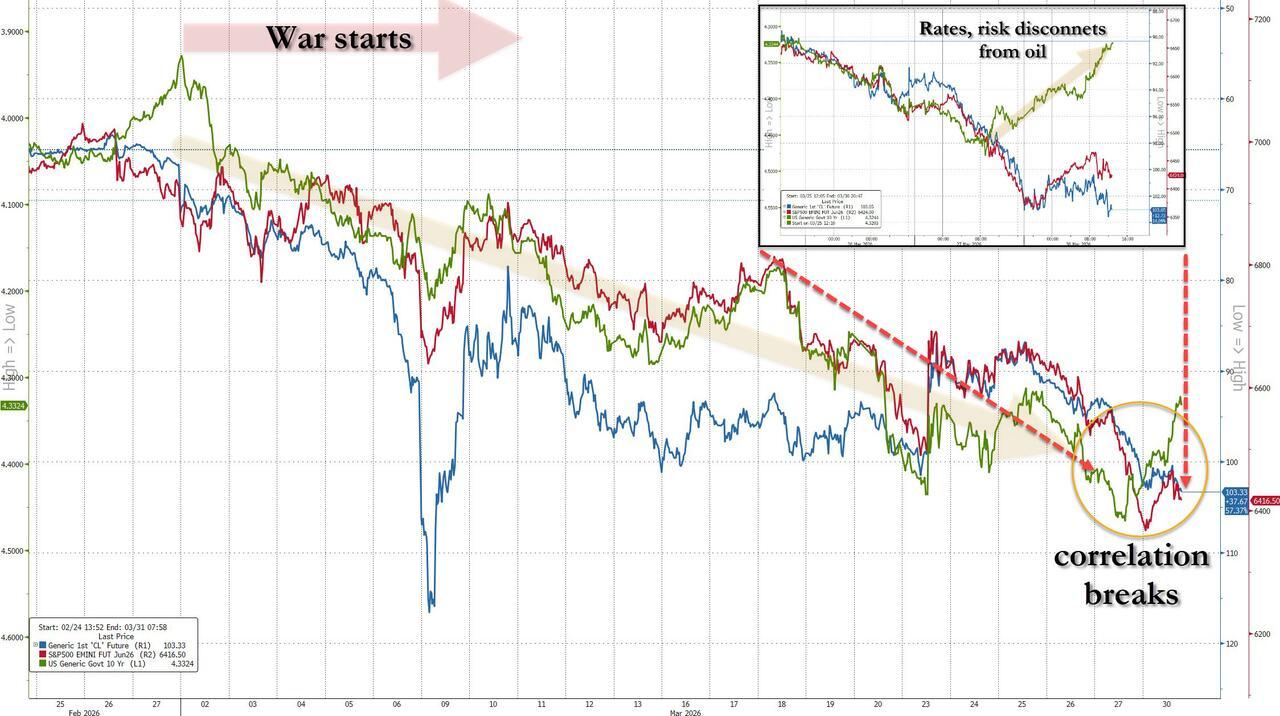
Teksten fremhæver dog, at der nu ser ud til at være sket et stemningsskifte. Tidligere steg olieprisen, obligationsrenterne og presset på aktierne nogenlunde i takt. Men nu er sammenhængen begyndt at bryde op: olieprisen er fortsat oppe over 100 dollar pr. tønde, mens de lange renter er begyndt at falde. Det tolkes som et tegn på, at markedet i stigende grad flytter fokus fra inflation til vækstnedgang. Investorerne begynder altså at tro, at krigens negative effekt på økonomien kan blive så stor, at den vil presse centralbanken til rentenedsættelser senere.
Bloomberg og flere obligationsforvaltere citeres for samme vurdering: godt nok er inflationen stadig et problem, men vækst- og tillidstabet kan efterhånden komme til at veje tungere. Derfor kan renterne falde, selv om oliepriserne forbliver høje.
Samtidig introducerer teksten en anden mulig forklaring på markedsbevægelserne: forventninger om finanspolitiske hjælpepakker. Morgan Stanleys rentestrateg Matthew Hornbach rejser spørgsmålet, om markedet allerede er begyndt at indregne, at regeringer vil forsøge at modvirke den efterspørgselsødelæggelse, som høje energipriser skaber, ved hjælp af finanspolitisk stimulans. Altså: hvis dyr energi rammer husholdninger og virksomheder hårdt, kan staten komme med støtteordninger, skattelettelser eller subsidier, som holder hånden under væksten.
Som eksempler nævnes Spanien og Portugal, der allerede har foreslået eller vedtaget tiltag for at dæmpe energipriserne. Pointen er, at hvis USA følger samme spor, kan det ændre hele markedets fortolkning af krisen. I stedet for kun at se højere oliepriser som en væksttrussel, kan investorer begynde at se dem som udløser for ny statslig stimulans. Dermed kan efterspørgslen blive holdt oppe, mens inflationen fra energipriserne består — og det kan i sidste ende tvinge centralbanken til en mere stram linje.
Morgan Stanley vurderer dog, at almindelig ekstra krigsfinansiering til Pentagon næppe er nok til at forklare markedets reaktion. Skal markedet tro på en finanspolitisk impuls, der virkelig ændrer rentebanen, må det være en langt bredere pakke, rettet mod de private aktører, der bliver ramt af stigende energiomkostninger.
Teksten kobler også denne udvikling til et mere grundlæggende skifte i investorernes tankegang efter pandemien. Før corona var den dominerende opfattelse, at centralbankerne var den vigtigste krisemekanisme: svag vækst gav lavere renter, høj inflation gav højere renter. Finanspolitikken kom ofte senere og var mindre afgørende. Efter pandemien mener forfatteren, at investorerne i højere grad ser regeringerne som den første og vigtigste krisereaktion, mens centralbankerne er blevet mere tøvende, fordi de hele tiden balancerer mellem vækstproblemer og inflationspres. Det betyder, at markedet hurtigere kan begynde at spekulere i offentlige hjælpepakker end i rentenedsættelser.
Til sidst rejser teksten endnu en risiko: at lande i Mellemøsten kan blive tvunget til at sælge amerikanske statsobligationer for at finansiere krig, forsvar og skader. Kuwait, Saudi-Arabien og De Forenede Arabiske Emirater nævnes som betydelige ejere af amerikansk gæld, og der henvises til data, som tyder på, at udenlandske monetære myndigheder allerede har reduceret deres beholdninger. Hvis sådanne salg tager fart, kan det lægge yderligere opadgående pres på de lange amerikanske renter, netop samtidig med at markedet forsøger at vurdere effekten af både vækstsvækkelse, mulig finanspolitisk stimulans og kommende centralbankreaktioner.
Samlet set fremstiller teksten et marked fanget i et komplekst dilemma. På den ene side truer højere oliepriser med at skade væksten og på sigt trække renterne ned. På den anden side kan finanspolitisk stimulans og eventuelle udenlandske salg af statsobligationer presse renterne op. Forfatterens konklusion er, at det endnu er uklart, hvilken kraft der vil dominere. Men udviklingen i guld, kryptovaluta og obligationsmarkedet tyder på, at investorerne i stigende grad forsøger at indregne netop denne usikre kombination af stagflationsrisiko, svagere vækst, mulig finanspolitisk støtte og uro på obligationsmarkedet.
Uddrag fra Apollo og Morgan Stanley
The longer the Iran war drags on, the more investors have to price in its lasting impact on inflation, growth, and government finances. Market positioning so far has been predictable: long Energy, short everything else. Factor-wise, it’s been about cutting duration – rotating out of growth and into assets that benefit from rising bond yields. Two sides of the same coin.
Yet despite the headlines, there’s been almost no increase in longer-term market inflation expectations. In fact, according to 5Y5Y inflation swaps – which help differentiate between short-term noise such as the current surge in energy prices, and entrenched inflation expectations – inflation over the next 5 Years is seen sliding by 20bps from the January highs and are now back to levels last seen during the April Liberation Day chaos.
Within equities, companies – and the analysts following them – are largely frozen, with upgrades and downgrades running neck and neck. In the S&P 500, quarterly earnings for this year have actually been revised up over the past month. Without downgrades, investors are likely to pile back in once the dust settles — whenever that may be. Timing that, of course, is impossible.
Meanwhile, turning to rates, Apollo’s Torsten Slok writes that while long-term interest rates are normally driven by Fed expectations, a premium has emerged, and 10-year rates today should not be at 4.4%, but instead at 3.9%. The sources of the rise in the term premium could be fiscal worries, QT, lower foreign demand or concerns about Fed independence, including the possibility that the Fed could in the future raise the inflation target, leading to greater inflation variability.
Apollo’s
bottom line is that “
the 10-year yield is 55 bps higher than where it should be, and investors need to think about why.”Well, it appears investors finally thought about it, and today for the first time we saw a decisive break in the strong correlation that emerged between the price of oil (higher, blue line below, inverted), 10Y yields (higher, green line below, also inverted) and stocks (lower, red line below), with yields making a clear break lower earlier today even as WTI spiked above $100, and last trading just over $103.
To be sure, many were waiting for this inflection point. In our morning wrap we said that “US yields fell across the curve after money markets cut the odds of a Federal Reserve rate hike in 2026 to about 20%, from around 35% on Friday. The rate on two-year Treasuries dropped five basis points to 3.87% while 10Y yields are down 7bps to 4.36% The dollar was little changed. Commodities are stronger as WTI moves above $100/bbl. Gold/precious and bitcoin are all higher despite USD strength, breaking the recent trend, as they start pricing in the looming stimulus to offset the next recession.”
Others agreed: as Bloomberg writes, while traders have so far largely focused on the inflationary shock from rising oil prices, sending the Treasury market toward its deepest monthly loss since October 2024, some of Wall Street’s biggest bond-fund managers said yields will slide as the war’s impact on growth becomes more apparent.
“While inflation remains a concern, the potential drag on growth and confidence should start to act as an offset, limiting further upside in yields,” said Francisco Simón, European head of strategy at Santander Asset Management. “Together with oil, we think the bond market is currently one of the clearest expressions of how markets are pricing the impact of the conflict on the macro outlook.”
And indeed, after a week of pricing in rate hikes by Dec 2026, today something snapped and the market is back to pricing in modest rate cuts by the end of the year, ostensibly in response to what traders view as bigger damage to the economy, which will offset Fed fears about the inflationary spike, forcing the Warsh Fed to aggressively cut rates.
Besides the monetary angle, and it remains to be seen how the Fed’s internal dynamic changes after Powell is replaced by Warsh, there is another explanation: as Morgan Stanley’s chief rates strategist
Matthew Hornbach writes,
the market may be increasingly considering the other side of the global demand destruction: fiscal stimulus, especially if today’s rates reversal… reverses, and yields spike yet again.
In his note ,
Hornbach asks rhetorically,
“might the US rates market increasingly reflect what may come as a result of energy-induced demand destruction: fiscal stimulus? We continue to rely on 1y1y CPI inflation swap rates as a guide to when oil prices may reach demand destroying prices, but also when or whether fiscal policy saves the day.“
Let’s take a closer look at Hornbach’s analysis.
The MS rates guru writes that as the Iran conflict enters its second month, the US rates market finds itself in a recently unfamiliar position: pricing in a significant probability of a rate hike by year-end. At one point last week, the market priced over a 50% probability of a rate hike in December. Exhibit 1 shows the March 2026 dot-plot and prevailing market prices. All points on the market-implied path for Fed policy sit well above what primary dealers and market participants expect from the Fed – causing confusion amongst investors trying to
understand why the market did what it did
As noted above, Morgan Stanley also
continues to monitor 1-year forward 1-year (1y1y) US CPI inflation swaps rates for clues on when the price of crude oil (and/or its distillates) reach the price that destroys demand (as noted earlier,
demand destruction is already rampant in Asia and parts of Europe, although the physical oil “shockwave” has not yet reached the US).
Here, Hornbach notes that the 1y1y rate went up after the conflict began, instead of down like it did after the April 2nd “Liberation Day” events
Using the above data, the MS strategist observes that “until the correlation between oil prices and the 1y1y US CPI inflation swap rate changes, we might conclude that oil prices remain below the price that destroys demand.”
But what else might we conclude? Might we conclude that the US government, understanding the demand destruction coming from elevated oil prices, could help alleviate the oil burden by passing a fiscal stimulus bill before the worst arrived? Others already have, among them:
- Spain’s government proposed €5bn in measures to ease energy prices, including VAT cuts and subsidies
- Portugal’s government approved a bill allowing temporary electricity price caps in case of an energy crisis.
The type of fiscal stimulus that could justify the price action must go beyond supplemental funding for the Iran conflict. Indeed, Morgan Stanley thinks Treasury would choose to finance any supplemental funding of the conflict via issuance of T-bills.
- Regarding supplemental funding, the bank’s public policy strategists note that the Pentagon already received roughly $840bn in the FY26 base defense appropriations bill, alongside an additional ~$150bn in supplemental funding passed via the OBBBA.
- They see a challenging path to passage of the additional ~$200bn that the media reported on.
Indeed, the bank does not think investors would view the size of the supplemental funding as driving a growth impulse strong enough to force an about-face from the Fed. If investors are actually contemplating a fiscal package that could force a hawkish pivot, “they must expect the package to go well beyond supplemental funding for the conflict. It must target private sector actors most affected by the rise in energy costs.”
Indeed, Morgan Stanley’s public policy strategists suggest that the politics around supplemental funding – as well as any targeted reactive fiscal policy tied to economic conditions – could change the longer this conflict lasts. Put differently, as the probability of supplemental funding approval rises, so too does the probability that additional stimulus could accompany it.
To be sure, the market pricing for Fed policy – taken at face value – suggests the discounting of some kind of growth impulse. As evidence, first, Hornbach takes the bank’s economists’ scenarios and compares them to market pricing. They changed their outlook scenarios and subjective probabilities in Fears of Rate Hikes Overdone
The charts above show that market prices look way out of line with the view of Morgan Stanley economists. When adjusting the subjective probabilities to produce a path that most closely aligns to the current market-implied path, there is a 41% probability on the “Demand upside”
scenario.
Price action in other parts of the macro markets suggests that a larger fiscal stimulus might be on investor minds. For example, US equity indexes showed greater resilience so far to the rise in oil prices than during the run up to Russia’s invasion of Ukraine (S&P 500 down ~6% from February 27 vs. down 13% into Russia’s invasion).
In addition, US Treasuries performed poorly vs. SOFR swaps since February 27 – hinting at growing concerns of US Treasury supply. Indeed, before the new capital rules came out, even 2-year Treasuries started to underperform SOFR swaps after February 27.
Speculation on more fiscal stimulus might also help explain why Treasuries did not respond to risk off in the expected way. Of course, not having a dovish Fed didn’t help Treasuries hedge riskier assets either.
All of this suggests that the pandemic and its aftermath may have changed how investors think about the policy response to crises involving growth.
- Prior to the pandemic, investors believed that the main response mechanism to crisis came from central banks. A growth crisis led to lower rates, an inflation crisis led to higher rates. Governments reacted, but after the fact and sometimes too late.
- Today, it seems that investors might believe that the main response mechanism to a growth crisis comes from governments, not central banks – where central banks may act too late because they deal with rolling inflation crises.
If accurate, that would suggest that US investors are starting to look past the demand-destroying effects of higher energy prices and toward the “fill-in-the-hole” effects of fiscal stimulus. If US fiscal stimulus fills in the demand hole created by higher energy prices, then higher energy inflation stands alone – increasing the chances of a post-pandemic central bank response.
Will central banks in the Middle East sell US Treasuries
Another complication arises when debating whither a fiscal (or monetary) stimulus is coming. Amid recent aggressive gold sales by the likes of Turkey and Russia, speculation might is rising that countries in the Middle East may need to sell Treasuries to finance defense and damage coming from the conflict. Kuwait, Saudi Arabia, and the United Arab Emirates (UAE) held a combined $313bn US Treasuries in January. In all three countries, holdings rose from 2022 – particularly in the UAE.
Custody holding data from the New York Fed suggest foreign monetary authorities sold ~ $58bn worth of Treasuries since Wednesday, February 25 – resuming a decline in Treasuries held at the institution that began a year ago.
At the same time, the New York Fed’s reverse repo program (RRP) for foreign and international monetary authorities (FIMA) only rose $3bn since February 27. This suggests that the proceeds from any Treasury sales or maturities that came out of the custody holdings didn’t flow into the FIMA RRP, and instead may have been repatriated by whoever sold their US debt.
Taking all of the above, it appears that while the bond market is starting to price in some (substantial) fiscal stimulus to offset the looming demand destruction shock (
according to JPM the oil shockwave will hit the US and especially California some time around April 15), the risk of a concurrent selloff of duration (we will have some more to say on the recent batch of surprisingly weak Treasury auctions in a subsquent post) as gulf states liquidate some of their TSY holdings, could put the bond market in a bind, with yields pushed higher on one hand on rising fiscal stimulus expectations, offset by the market’s expectations of how the Fed will need to react to a sudden unanchoring of the long end should the US bond market suffer a sudden selloff in the long-end.
It is unclear which way this conundrum will resolve, although judging by today’s sharp rebound in both precious metals and crypto, the market is certainly starting to price at least some of it.