Resume af teksten:
EU-landenes sårbarhed over for energichok afhænger af deres importafhængighed og evne til at håndtere forsyningsforstyrrelser. Belgien, Spanien og Italien er blandt de mest udsatte lande for stigende olie- og gaspriser, med Belgien som det mest sårbare. Belgien har en energieffektiv økonomi og høj fossile brændstofforbrug, mens Italien og Belgien har stor eksponering mod Mellemøstlige fossile brændstoffer via LNG. Begrænset finanspolitisk råderum i Frankrig, Belgien og Italien hindrer deres evne til at yde økonomisk støtte under energikrisen. Desuden påvirker højere renter lande som Frankrig og Italien betydeligt, med stigende låneomkostninger, mens Belgien er mindre påvirket grundet længerefristet gældsstruktur. Samlet set er Belgien mest udsat for energikrisen, efterfulgt af Italien og Frankrig, mens Spanien har større økonomisk fleksibilitet til at håndtere chok.
Fra ABN-Amro:
In light of what is shaping up to be one of the biggest global energy supply shocks in history, the question arises on how exposed EU countries are to potential energy shocks. In this note, we assess such exposure by looking at both dependency—how much nations rely on external sources for their oil and gas—and resilience, meaning their capacity to withstand and adapt to disruptions or price surges. By examining these factors, we can better understand which countries face the greatest risks and which demonstrate stronger ability to cope with sudden changes in energy supply or cost.

Larissa de Barros Fritz
Senior Fixed Income Strategist (Credit)
EU exposure to energy shocks depends on both import dependence (oil/gas sourced abroad) and resilience (ability to absorb supply disruptions and price spikes)
A more complete view of vulnerability combines fossil fuel import-dependency rates with shares in Gross Available Energy (system level) and Final Energy Consumption (end-user level)
Belgium, Spain and Italy are among the most exposed to higher oil and gas prices…
…But Belgium is more at risk due a more energy-intensive economic structure
Greece shows the highest reliance on Middle East fossil fuels overall, while Italy and Belgium have notable Middle East exposure via LNG
Limited fiscal space in France, Belgium and Italy constrains governments’ ability to cushion households and firms through subsidies or tax relief
Adding to that, a high interest rate environment lifts interest costs and deficits, with France and Italy most affected, while Belgium is less affected due to smaller near-term refinancing needs
Overall, Belgium emerges as the most vulnerable big six eurozone country to the current energy crisis, due to its high fossil‑fuel reliance, energy‑intensive economy, dependence on Middle Eastern imports, and limited fiscal space to absorb shocks
When assessing which EU countries are most vulnerable to rising energy prices and reduced supply from the Middle East, it is essential to consider a range of metrics relating to oil and gas dependency. A meaningful comparison requires combining measures of import dependency with how heavily oil and gas feature in both the energy system and final consumption.
The first metric to take into account is the EU pre-defined energy import dependency metric. This metric (shown in a percentage format) ranges from 0% to 100%, and indicates the share of total energy needs of a country that is met by imports from other countries. Hence, the rate shows the proportion of energy that an economy must import. For crude oil, this indicator is close to 100% for almost all EU countries, reflecting the near absence of domestic production (for the EU as a whole, oil import dependency stands at 97%). Gas dependency is somewhat lower but still high, at around 85% for the EU. While informative, this metric alone does not capture how exposed countries are in practice.
As such, we add another layer to our analysis. We examine the Gross Available Energy (GAE), which measures the energy available to an economy (via domestic production, net imports and stock exchanges) before transformation. GAE, however, reflects system‑level dependence rather than the exposure of households and firms. Hence, we add Final Energy Consumption (FEC) to our analysis as it captures the energy actually used by end‑users. FEC is a bottom-up aggregation of energy consumption, rather than supply, which is captured by GAE. Hence, together, GAE and FEC allow us to assess both supply‑side dependency and demand‑side vulnerability, recognizing that supply composition and import reliance only becomes relevant when it impacts the fuels that consumers and businesses actually use.
Viewed through this combined lens, several countries stand out. On the supply side (GAE), Spain and Belgium exhibit high oil dependence, as a large oil share coincides with near‑total import dependency (see left chart below). Greece, Ireland, the Netherlands and Portugal also show elevated oil exposure. For gas, Italy is particularly vulnerable, with both a high import dependency and a large gas share in GAE. Combining import dependency with fuel shares in GAE (by multiplying both, see chart at the bottom of the page) shows Greece and Ireland as the most exposed overall, followed by Belgium, Spain and Italy, albeit for different reasons.
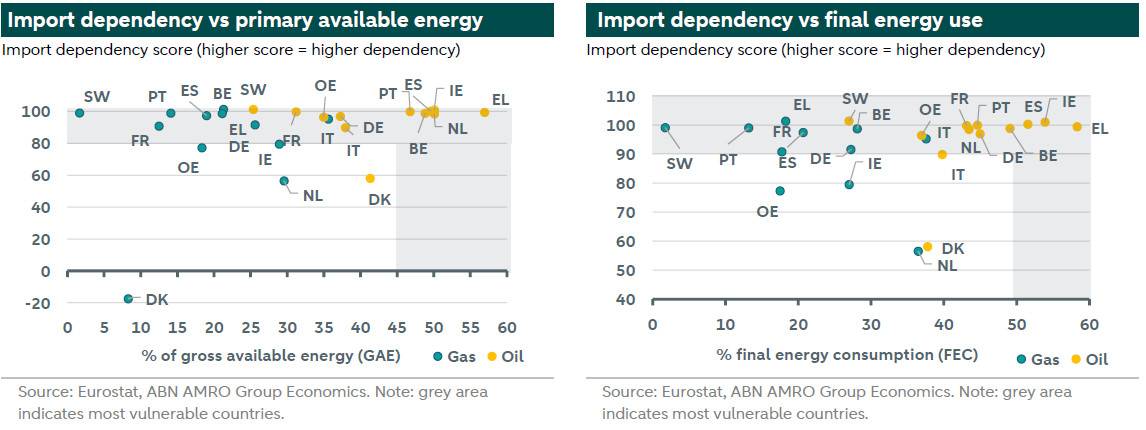
However, exposure can look different once we account for how energy is actually consumed. In FEC, electricity is treated as a separate fuel, which means fossil fuel exposure would be understated if electricity generation were ignored. Hence, to address this, we adjust oil and gas consumption by adding the share of electricity produced from fossil fuels.
When comparing Italy and Spain on the demand side (FEC), the conclusions largely mirror those derived from the supply side (GAE). Again, Spain’s economy shows only a marginally higher fossil fuel exposure than Italy’s, driven by its very high oil consumption (around 50% of FEC) and near‑total import reliance, despite Spain’s much lower gas use compared with Italy (21% vs 38%). However, the comparison with Belgium changes materially once we shift from supply (GAE) to demand (FEC). While Spain and Belgium display broadly similar combined fossil‑fuel exposure when assessed through GAE, Spain is clearly in a stronger position when exposure is measured via FEC. Belgium’s higher demand‑side exposure is primarily driven by its heavier reliance on gas. This reflects structural differences in how gas is used: in Belgium, gas is predominantly consumed directly by end‑users, whereas in Spain gas is mainly used for power generation and thus enters final demand largely through electricity. As a result, and when combined with high import dependency, Belgium appears particularly vulnerable to disruptions in global oil and gas markets (see left chart below).
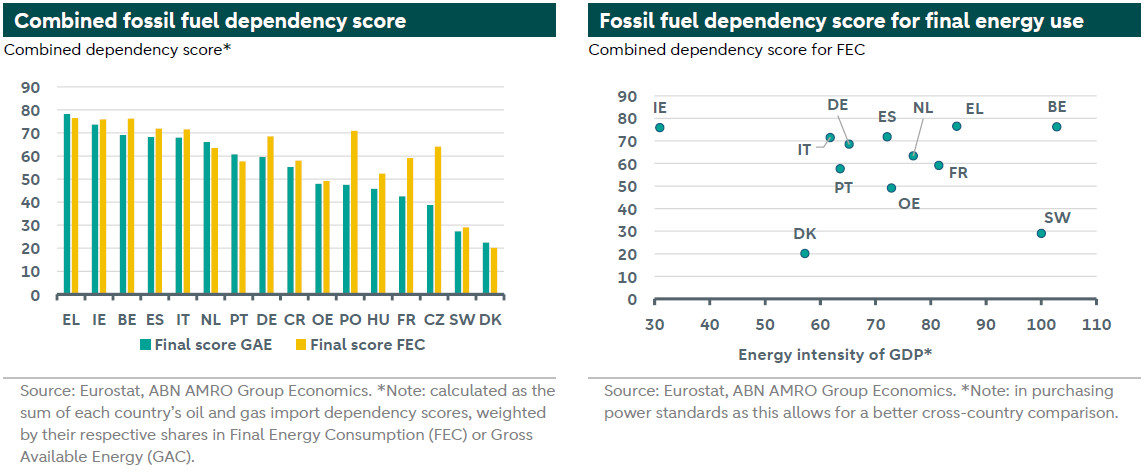
Finally, we assess each country’s energy intensity of GDP. This metric indicates how much economic output depends on energy‑intensive activities and therefore how vulnerable GDP is to an energy price or supply shock. The right chart on the previous page shows high fossil fuel dependency does not always translate into high economic vulnerability. Ireland is a clear example: despite strong oil and gas dependence, its economy is less energy‑intensive, as services account for around 60% of GDP. Comparing Spain and Italy, both display similar overall dependency scores—based on import dependency and fossil fuel shares in FEC—but Spain’s economy relies more heavily on energy‑intensive activities. Belgium stands out most clearly, combining high fossil fuel dependency with a large share of GDP dependent on energy, making it particularly exposed to energy shocks.
Another important layer to this analysis is to look specifically at how much of that fossil fuel comes from the Middle East. For example, if gas is mainly supplied from Norway, supply disruptions from the Middle East should have minimal impact for a country. In this case, the impact is mostly indirect, via higher gas prices.
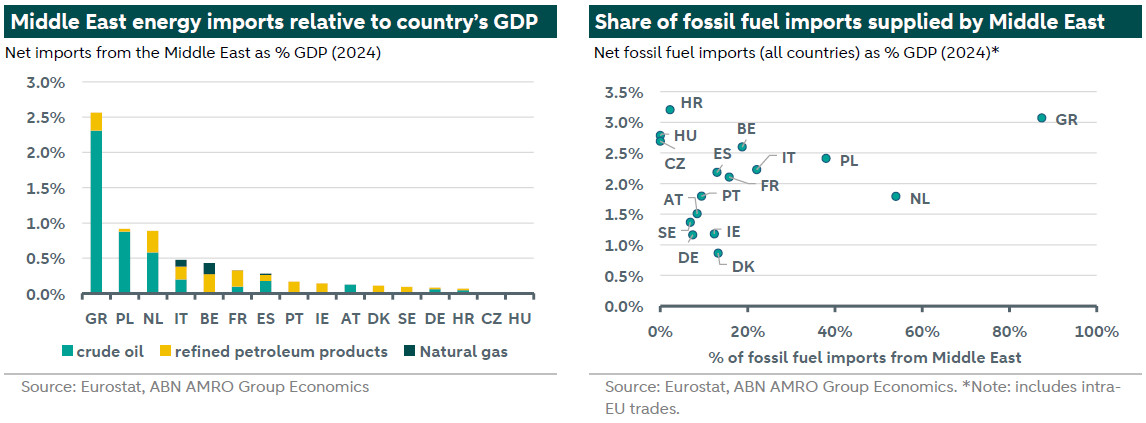
We therefore examine net fossil fuel imports from Middle East countries to the EU relative to each country’s GDP. The chart on the left below shows that Greece, Poland and even the Netherlands are large importers of Middle Eastern oil, while gas exposure (mainly in the form of LNG) is high for Italy and Belgium.
To further investigate reliance on Middle Eastern imports, we combine total net fossil fuel imports (as % of GDP) and the proportion of those imports sourced from the Middle East (see chart on the right below). Once again, Greece stands out with high fossil fuel imports relative to GDP and a large amount of these (~87%) coming from the Middle East. Belgium, by contrast, also has a sizeable share of net fossil fuels imports (~3% of GDP), but only about 20% of this is supplied by the Middle East.
Looking particularly at Spain and Italy, we see that both have more or less the same amount of net imports from fossil fuels (relative to GDP), but Italy has a higher reliance on Middle East to meet those import needs. That is mainly driven by Italy’s imports of LNG. In fact, in 2024, 43% of the total value of Italy’s LNG imports was supplied by the Middle East. Also Belgium sources around 35% of its LNG from the Middle East, making it also very vulnerable to LNG supply disruptions.
Another important aspect of this analysis involves identifying not only which EU countries are most vulnerable to the current energy crisis, but also which ones have sufficient capacity to mitigate its effects. The higher oil and gas prices has already resulted in EU countries taking initiatives to cushion the potential negative effect on inflation. For instance, the Spanish government approved a package of tax cuts worth EUR 5bn (0.3% of 2025 GDP), which includes temporary suspension of the tax on the value of electricity production. Italy is also on the way to approve a EUR 3bn (0.1% of GDP) package (pending Senate approval) that provides relief for households and industry by lowering wholesale electricity prices.
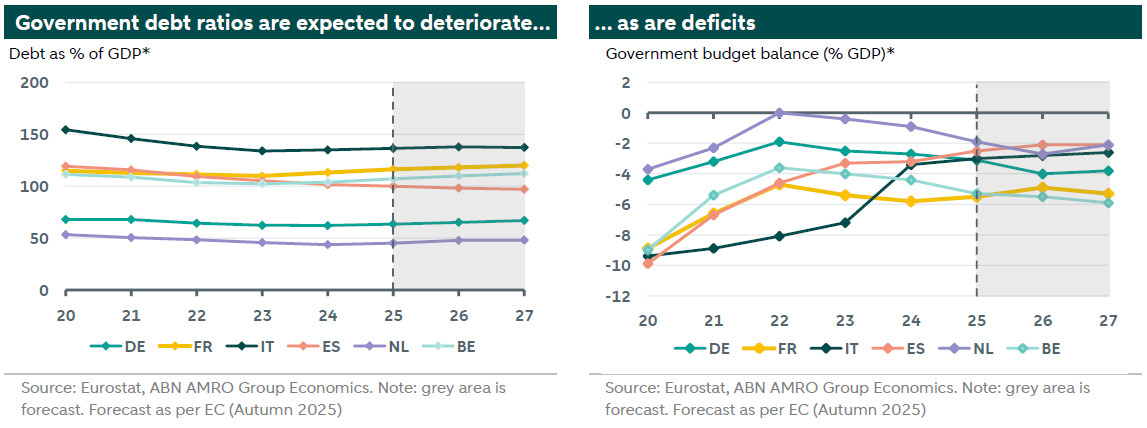
However, EU countries are bound to comply with the EU’s Stability and Growth Pact, designed to ensure member states maintain sound public finances. If countries breach the either the 3% GDP deficit limit or the 60% debt-to-GDP rule, the Excessive Deficit Procedure (EDP) can be activated. Countries that currently do not comply with this have the next few years to ensure that these metrics return to required levels. For example, France and Belgium have until 2029 to end the excessive deficit procedure (5.8% and 4.5% in 2024, respectively), while Italy has until 2026 (a deficit of 3.4% in 2024 and a recently announced deficit of 3.1% for 2025).
For that, we look at countries’ ability to increase debt amid the current situation. Currently, the European Commission (EC) expects that the debt ratios of all EU countries will increase, with the exception of Spain (see here ). Notable jumps are for Belgium (from 104% in 2024 to 112% expected in 2027) and France (from 113% in 2024 to 120% expected in 2027). Furthermore, the EC forecast expects all big six eurozone countries to exceed the 60% debt ratio threshold, with the exception of the Netherlands. Looking at deficits, also here the picture is not so encouraging, especially given the challenges most countries have regarding the increased defence spending and ageing societies. Based on the EC forecasts, budget balances are expected to deteriorate across all countries, with the exception of France, Italy and Spain. Nevertheless, deficits are expected to remain above the 3% threshold for Germany, France, Italy and Belgium. Notably, Belgium and France are also expected to sustain deficits above the 5% levels. Hence, many European governments are not really in a position to undertake higher spending to help cushion the blow from higher energy prices – at least, not without offsetting measures elsewhere.
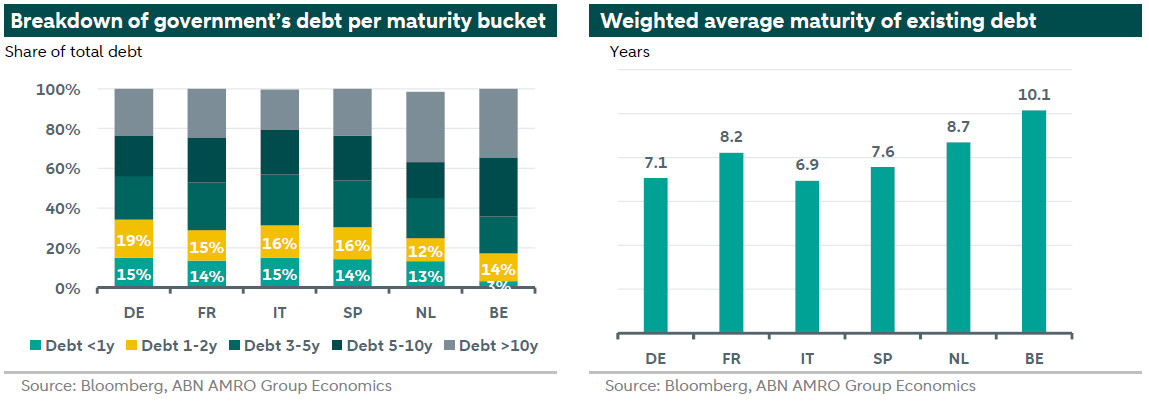
Meanwhile, government bond yields have been on a rising trend as markets price in ECB rate hikes as well as higher inflation expectations. If sustained, higher bond yields will eventually feed into government budgets via higher interest rate expenses. In order to evaluate how vulnerable EU countries are to this, we analyzed what the impact of higher interest rates will be on government deficits. The reinvestment risks differs per country, depending on the share of the maturing debt in the coming years. In our analysis, we looked at the debt maturing in the coming two years (excluding loans and deposits which are also components of a government’s debt). The chart on the left shows that over 30% of Germany’s and Italy’s debt (bonds and bills) will mature in the next two years. These countries also have the shortest weighted average time until their debt matures—7.1 and 6.9 years, respectively (see right chart below). In contrast, Belgium’s debt is more long-term, averaging 10.1 years. Most countries have extended the maturity of the outstanding debt during the years when interest rates were (very) low in the period between 2015 and 2022.
Countries such as France and Italy are expected to face a significant rise in interest expenses (see chart below on the left). That is mainly because a large share of their debt will mature in the near term which must be refinanced at yields that are much higher than the coupons on existing debt. France, for example, currently pays an average 0.2% coupon on debt maturing within one year and 1.4% on debt maturing within 1-2 years. By contrast, current market yields are around 2.6% for one-year bonds and 2.7% for two-year bonds, implying a substantial step-up in borrowing costs as refinancing occurs. The borrowing costs for the net new supply, mainly because of the budget deficit, will be even higher as this new debt will be issued further along the curve where interest rates are higher. Our forecast for interest expense is also relatively higher than the forecast from the EC in November last year because, back then, the EC incorporated market expectations that the ECB policy rate might fall below 2% in 2026. However, yields are now significantly higher than what they were in November 2025, which is reflected in our calculations.
Higher interest expenses will inevitably translate into higher government deficits. Given that our interest expense forecast deviates significantly from the EC’s forecast for mainly Italy and France, these two countries are also expected to record higher deficits than anticipated by the EC. Notably, the EC expected both Italy and France to be on a deficit-reduction trajectory from last year onwards. However, the prevailing yield levels suggest a different outcome: French deficit is now expected to remain broadly stable to the 2025 forecast (while the EC was initially forecasting a reduction of 0.6pp for 2026), while the Italian deficit is projected to edge up from the 2.8% expected by the EC for this year to 3.2%. Also Spain would be negatively hit by the higher interest rate environment, with its deficit shooting up to 2.5% from 2.1% initially expected by the EC for this year. By contrast, Belgium and the Netherlands are the countries least affected by the rising interest rates. This largely reflects their relatively small share of short‑term debt within total outstanding debt. In Belgium’s case, the impact is further limited by the modest net issuance expected for this year, of only around EUR 4bn. For the Netherlands, refinancing pressures are also cushioned a less significant rise in yields. For example, the average coupon on its existing 1-2y debt is only 30bps below the current yield on the 2y DSL. Nevertheless, both countries are expected to increase deficit compared with 2025 and Belgium would still deliver an elevated deficit, significantly above the 3% threshold set by the Maastricht Treaty.
It is important to note that this exercise assumes that interest rates remain high for a long period of time, given that we assume that all debt maturing in the next 2 years would be refinanced at the current yield levels. As such, the impact is much more benign if one were to assume that rates will fall in the coming months (in which is our current base case).
From this exercise, it is also possible to infer how the deficit is expected be impacted by a significant rise in bond yields. The charts on the next page project the deficit of Italy and France across different yield levels. In this case, we assume that the spread between long-term debt and short-term remains constant, such that if long-term bond yields rise, so do yields on short-term debt (please refer to the box below for details on our methodology). What can be inferred from this is that rising yields can be a drag for government’s finances. For example, if bond yields double from 3% to 6%, French and Italian deficits would increase by 0.9% and 1.1%, respectively.
Overall, the analysis highlights clear divergences in EU countries’ vulnerability to the energy shock. Belgium, Spain and Italy stand out as the most exposed to rising energy prices, reflecting their high reliance on fossil fuels across both gross available energy (GAE) and final energy consumption (FEC), combined with a strong import dependence. Among the three, Belgium appears the most vulnerable, as its economy is also more energy-intensive, amplifying the impact of energy price shocks.
At the same time, Italy, Belgium, France and Spain are materially exposed to developments in the Middle East, given the sizeable share of their fossil fuel imports originating from the region, which increases their sensitivity to both price spikes and supply disruptions.
Crucially, this external vulnerability is compounded by constrained fiscal space. France and Belgium face very high debt and deficit levels, while Italy’s vulnerability is driven primarily by its elevated debt ratio. As a result, these countries have limited room to deploy fiscal measures to shield households and firms from higher energy costs. This constraint is particularly binding for France and Italy, which are also among the most sensitive to rising interest rates, implying that higher yields will increasingly weigh on public finances.
Taken together, Belgium emerges as the main loser from an intensifying energy crisis, followed by Italy and France. Belgium is among the countries with the highest fossil fuel shares in its energy mix, has a GDP that is energy-intensive, and remains heavily dependent on Middle Eastern imports, while its high debt and deficit levels further limit its ability to cushion the impact, despite a lower sensitivity to rising rates. Italy combines high fossil fuel exposure, significant reliance on Middle Eastern supply and a high debt burden, leaving little capacity to absorb further shocks. France is less dependent on fossil fuels overall, but still relies on the Middle East to source a large share of its energy imports (particularly LNG). At the same time, its elevated deficits, high debt and pronounced interest rate sensitivity leave France with very limited room to absorb additional shocks, especially if further disruptions materialize. Spain, by contrast, also shows high fossil fuel reliance and import exposure, but stands out for its relatively greater fiscal space and resilience, supported by improving debt and deficit dynamics, which provides a stronger buffer against the shock.
Larissa de Barros Fritz
Senior Fixed Income Strategist (Credit)
Hurtige nyheder er stadig i beta-fasen, og fejl kan derfor forekomme.