

Fra Danske Bank:
Sofie Grundvad Pedersen, [email protected] , Assistant Analyst
For mobile users we recommend the web-version * including the FI and FX morning comment
*Restricted access – only for professional investors and investors domiciled in and a resident of an EEA member state.
Focus will continue to be on developments in the Middle East and the bond market rout that has caused a sell-off in risk assets.
In the UK a fresh labour market report will be published. Employment is expected to have fallen again in March, although the earlier, concerning rise in unemployment has since been revised lower.
Economic calendar
In Japan, Q1 real GDP grew at an annualised 2.1%, equivalent to 0.5% q/q, outpacing the consensus forecast of 1.7% and the revised 1.3% recorded in the previous quarter. Growth was broadly based, with both private consumption and capital expenditure rising 0.3%, while net external demand contributed 0.3pp, underlining the role of solid exports. The figures suggest the economy was on a relatively firm footing before the Iran war and its associated energy shock, giving it some buffer, but momentum is expected to slow in the second quarter as the full impact on businesses and households becomes clearer.
In the US-Iran war, Tehran has submitted a new response to the latest US proposal via Pakistan, though mediators warn the ceasefire is “on life support”. Brent Crude slipped around 2% to USD109.8/bbl in early Asian trading after President Trump said he had paused a planned large‑scale strike on Iran to allow time for negotiations aimed at ending the war in the Middle East. Yet Trump insists the US remains ready to act if talks fail. At the same time, Washington extended a sanctions waiver on Russian seaborne crude, helping stabilise physical supply, while record US reserve draws have pushed inventories to two‑year lows, leaving the market highly sensitive to any renewed escalation.
In the bond market, investors are increasingly pricing in a lasting inflation shock from the Iran war, triggering a global bond market rout, with G7 10-year yields surging towards 4% and 30-year rates to about 4.6%, and US Treasuries and JGBs at multi-year highs. Yesterday, however, the sell-off abated as lower oil prices helped temper inflation concerns, prompting a retracement in yields and improved risk sentiment, even though markets still see a durable agreement as distant.
In the euro area , European Commissioner Valdis Dombrovskis flags a “stagflationary shock” from the war in Iran in an interview with CNBC , noting that the forthcoming spring report will lower growth forecasts and raise inflation expectations. Persistent disruption in the Strait of Hormuz and oil above USD100/bbl are key drivers. His comments reinforce expectations of softer activity, stickier inflation and limited policy space to cushion the shock.
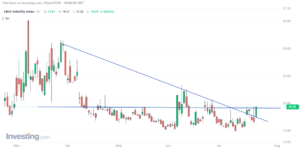
Equities: Equity markets moved lower yesterday, driven by US tech underperformance and a clear defensive rotation. What is important, however, is that this was not a classic broad-based risk-off session. Most sectors were actually higher on the day, and VIX also declined. In other words, the move was more about sector rotation out of high-flying semiconductors than a general deterioration in risk appetite.
We are seeing some of that same dynamic continue in Asia this morning. Taiwan and South Korea are notably weaker after what has been truly exceptional year to date gains, with the semiconductor complex underperforming after the pressure seen in the US yesterday.
It is also worth highlighting the turnaround we saw in Europe yesterday. Markets started the day in the red but managed to close higher, which is a constructive signal in a session otherwise dominated by pressure on the most crowded parts of the equity market. Energy was the best performing sector in both the US and Europe, as oil crept higher. Hence, this also signals Iran remains one of the biggest daily drivers for markets at the moment.
This morning, Asian markets are mixed. European futures are higher, while US futures are lower, again with tech somewhat under pressure.
FI and FX: The sell-off in global FI markets has stabilized in the last 24 hours with importantly the short-end of the USD curve even coming lower driving a slight steepening of the curve. Despite Trump’s announcement that he will be holding back strikes on Iran today, Iran’s updated peace proposal and the news of another US waiver on the selling of Russian oil that has already been loaded on tankers the impact on energy and hence broader markets has still been rather limited. EUR/USD retreated some of its decline from last Friday but continues to trade around 1.1650. In the Scandies both SEK and NOK have stabilized and are marginally stronger vs the EUR since Monday’s opening.
See also our in-depth FI and FX morning comment *
Reading the Markets USD – The case for a tightening bias , 19 May
Riksbank Minutes – May 2026 , 13 May
Global Inflation Watch – Shelter inflation boosts US CPI in April, 12 May
Research US-China – Xi-Trump meeting preview: We expect no game changers, 12 May
Spending Monitor – spending broadly unaffected by higher fuel prices , 12 May
Geopolitical Radar: The Devil is In the Details, 8 May
Report completed: 19 May 2026, 07:00 CEST
Report first disseminated: 19 May 2026, 07:30 CEST
Disclosures/disclaimer
*For a definition of ‘Professional Investors’ under MiFID II (Market in Financial Instruments Directive 2014/65), go to the FAQ. To change your disclaimer settings, go to ‘Research Disclaimer’ at the footer of research.danskebank.com.
Hurtige nyheder er stadig i beta-fasen, og fejl kan derfor forekomme.