Resume af teksten:
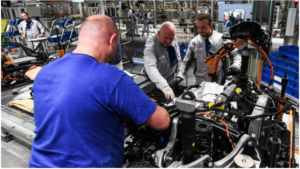
Den tyske fremstillingssektor oplever en genopblussen, hvilket skaber ny fremdrift i eurozonen økonomien og forbedrer det kortsigtede perspektiv. Eurozonens PMI steg til 51,9 i februar fra 51,3 i januar, med fremstillingssektoren der nåede over 50-mærket for første gang i næsten fire år. Tyskland ser ud til at påtage sig en rolle som vækstmotor i eurozonen, mens Frankrig bidrager mindre til væksten. Økonomisk opsving i eurozonen medfører også stigende inflation, idet både inputomkostninger og salgspriser stiger, især i fremstillingssektoren. Disse udviklinger bidrager til en følelse af økonomisk normalitet i lyset af politisk uro og spekulationer om ændringer hos ECB.
Fra ING:
A comeback for German manufacturing has sparked new momentum in the eurozone economy, brightening the short-term outlook

It now looks as though Germany and France could reverse roles when it comes to their impact on eurozone growth
The eurozone PMI increased to 51.9 in February from 51.3 in January. This is the highest level since November last year. While the manufacturing PMI surged to 50.8 from 49.5 in January, the services PMI improved only marginally to 51.8 from 51.6.
Looking at the larger eurozone countries, the silent rebound of the German economy occurring under the surface continues, with the PMI composite reaching a four-month high and the PMI manufacturing crossing the magic 50-threshold for the first time in almost four years. As business sentiment in France basically stagnated, it indeed looks as if the two largest eurozone economies could swap their roles for eurozone growth, with Germany becoming a growth driver and France, in turn, proving a drag on eurozone growth.
And as the economic rebound in the eurozone appears to gain momentum, inflation – at least as measured in the PMI surveys – is also on the rise again. Both input costs and selling prices were raised in February, with a faster rise in manufacturing selling prices than in services.
Overall, at the end of a week that was dominated by the aftermath of last week’s informal European summit and this week’s rumours of a possible early exit for Christine Lagarde from the ECB, this morning’s PMI readings bring back some economic normality. And it’s a pleasant reality. We’ve previously discussed the German ketchup bottle effect; it now finally seems to be happening. Driven by a rebound in German manufacturing, the eurozone economy is gaining momentum, leaving the geopolitical tensions of the past behind – at least for now.
Hurtige nyheder er stadig i beta-fasen, og fejl kan derfor forekomme.