
Resume af teksten:
Geopolitical tensions in Iran have led to fluctuations in oil prices, particularly affecting the Strait of Hormuz, a critical oil transit route. Although oil prices experienced volatility, they have decreased significantly from highs earlier in the year. The market’s ability to adapt to the supply shock is partly due to alternative routes and agreements among global powers to ensure the free passage of oil. Meanwhile, China’s economy showed strong growth in Q1, with a 5.0% increase in GDP, driven by robust exports and infrastructure investment. Despite geopolitical concerns, China’s structural resilience in energy offers some protection against global disruptions. Market reactions to geopolitical tensions highlight the difficulty for investors to anticipate outcomes, making it predominantly a trader’s market. Real assets and oil equities have yet to build lasting strength amid these developments.
Fra Julius Bär:
It is entirely possible that the latest conflict in Iran will eventually be remembered less as a singular rupture than as one stage in a decades-long Middle Eastern conflict. This matters because markets increasingly seem to think in a similar way.
Geopolitical tensions and oil prices: How markets are adjusting
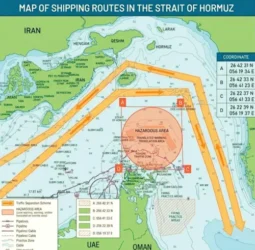
Geopolitics can be chaotic, especially during phases of conflict. The Strait of Hormuz had been declared open and closed within a few hours over the past weekend, causing oil prices to zigzag down and up. Looking beyond the past days’ volatility, most energy prices are down meaningfully from the current crisis’ highs posted in the end of March and early April. Jet fuel prices in Europe, one of the epicentres of the current crisis, are down around 20% from the highs and back below the levels seen in 2022. The easing observed more broadly on financial markets is not only expectation- and investor-mood-driven but mirrors the easing in real-world energy markets.
While the events over the weekend brought transit through Hormuz to a standstill, the days before it saw oil flows over 4 million barrels per day, or roughly around 2 million, excluding Iran. The oil market remains in deficit, but closer to 5% than 10%. These Hormuz transits, on top of the alternative routes, provide the oil market with some breathing room to adapt and partially absorb the supply shock. Geopolitics needs no lasting resolution for the oil market to normalise. Neither the United States nor Iran have an interest in hindering the passage of oil or gas destined to China, India, or other Asian buyers. Based on this common ground, we believe that trade around Hormuz is likely to be incrementally restored, temporarily dented, or accelerated by geopolitics. Yet it remains unclear, for the time being, by which exact dynamics and mechanisms.
China: Growth rebounds
Amidst the conflict in the Middle East, Chinese economic growth gained momentum in Q1, with real GDP expanding by 5.0% y/y, up from 4.5% in Q4 2025. The rebound exceeded both consensus and our own expectations. Stronger export growth, together with a pickup in infrastructure investment, drove the growth acceleration. Robust external demand supported industrial output, especially in high‑tech manufacturing, which maintained strong momentum. Fixed-asset investment stabilised following a broad contraction in the second half of 2025. While infrastructure investment picked up supported by front-loaded government spending in that area, the ongoing downturn in the property sector remained a drag on overall investment growth. Meanwhile, domestic consumer spending weakened in Q1. Retail sales recorded only modest growth during the quarter.
Overall, the latest data confirms a rebound from late‑2025 softness, driven by strong exports and solid production, while consumer spending and housing activity remain subdued. The stronger-than-expected Q1 growth pushes up our 2026 growth forecast to 4.5%, from 4.3% previously. However, uncertainty related to the energy shock remains elevated. Although China is less vulnerable than some of its Asian neighbours, as its structural resilience in the energy sector puts it in a better position than many other countries, it is not immune to the far-reaching global economic repercussions.
What does this mean for investors?
Historians may one day file away the latest Iran war as just another chapter in a Middle Eastern conflict. Markets are already behaving that way. They absorb energy shocks, reprice war turns almost instantly, and keep testing the resilience of economies, supply chains, and investors alike. That makes war a trader’s market first – and only at extremes a true investor’s opportunity.
Put plainly, the number of armed conflicts may still rise because the gloves are off and the hegemons may be wary of interfering. For portfolios, however, the harder lesson is that beating the market on war outcomes is exceptionally difficult. Unless one holds a very clear medium-term view and is willing to act against extreme price moves, war remains a trader’s market for 90% of investors or more. Only when markets overshoot badly does it become an investor’s opportunity. And while we continue to favour real assets, one point remains notable: oil and oil equities still seem unable to build lasting relative strength. All of these observations remain provisional and open to constant review.
Hurtige nyheder er stadig i beta-fasen, og fejl kan derfor forekomme.