Resume af teksten:
Den Europæiske Centralbank (ECB) har besluttet at holde sine rentesatser uændrede, med præsident Christine Lagarde der angiver, at der ikke er hastværk for at ændre situationen. Tidligere udtalelser om potentielle renteforhøjelser blev modificeret, og alle muligheder – inklusiv rentenedsættelser – er stadig på bordet. ECB forventer, at eurozonens BNP-vækst vil ligge på 1,2% i 2026, stigende til 1,4% i 2027 og 2028. Inflationsprognoser antyder en svag stigning til 2% i 2028, påvirket af faktorer som EU’s Emissions Trading System. Lagarde kommenterede desuden muligheden for at bruge indefrosne russiske aktiver og omtalte diskussioner om sin succession i 2027. ECB’s nuværende ‘gode sted’ i rentepolitik betragtes derfor som passende med få incitamenter til ændringer.
Fra ING:
The European Central Bank has kept its policy rates unchanged, and comments during the press conference show that there is no rush to change anything
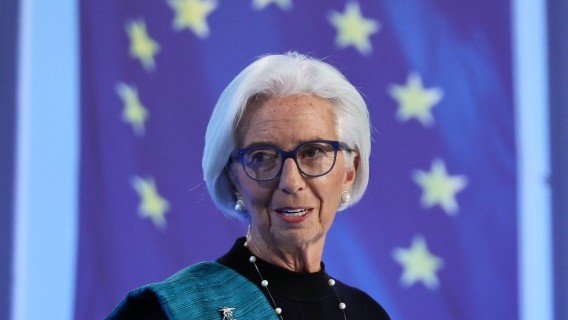
ECB President, Christine Lagarde at Thursday’s press conference
We last had an ECB rate cut in June, and keeping interest rates unchanged for more than six months is sending a strong signal that it would need a severe downward shift in inflation and growth (expectations) to get the central bank into cutting mode again. In fact, the ECB’s so-called “good place” is simply a neutral monetary policy stance.
As noted, the hurdle to moving from neutral to actual easing remains high. This was clearly confirmed by ECB president Christine Lagarde’s comments during the press conference, where she not only confirmed the relatively benign macro outlook, albeit surrounded by high uncertainty, but also stressed the so-called optionality for future meetings. In other words, Lagarde somewhat undermined earlier comments by board member Isabel Schnabel that the next ECB rate change would be a hike. Instead, at least according to Lagarde, all options – cut, hike, on hold – remain equally on the table.
Staff forecasts paint a rather benign picture of growth and inflation outlook
While the decision to keep interest rates on hold was expected, all eyes were on the latest ECB staff projections. The inflation forecasts, in particular, provide more evidence that the Bank’s current ‘good place’ is also the right place.
In the staff projections, eurozone GDP growth is expected to be 1.2% in 2026, 1.4% in 2027, and 1.4% in 2028. Underlying these forecasts is a profile of slightly stronger GDP growth of 0.4% quarter-on-quarter from Q2 26 to Q4 26, driven by fiscal stimulus. For 2027 and 2028, ECB staff appear to have chosen the safe option, assuming a solid quarterly profile of 0.3% QoQ growth, refuting any talk of structurally weaker growth.
Headline inflation is expected to be 1.9% in 2026, 1.8% in 2027, and 2.0% in 2028. The slight upward revision to the 2026 forecast is the result of a slower-than-expected drop in services inflation, while the 2027 drop will be the result of the delayed implementation of the second phase of the EU’s Emissions Trading System (ETS2).
Looking at the underlying profile shows headline inflation below 2% in the second half of 2026 and all of 2027 before moving to 2% and slightly above due to the ETS2 implementation. Overall, even if the ECB abolished the former definition of price stability – “below but close to 2%” – the irony is that the latest forecasts are exactly predicting this outcome.
On Euroclear and her own succession
Lagarde made two additional comments during her press conference. On the hotly debated use of frozen Russian assets, Lagarde said that European leaders would find a solution but that it was not for the ECB to breach the rules of the European Treaty regarding monetary financing.
The other one was on her succession, in 2027, and Isabel Schnabel as a potential candidate, where Lagarde said that the matter had been twice looked into, and the expert answer had always been that an Executive Board member cannot return to the Board in a new role.
In our view, the Treaties are clear: Executive Board members are appointed for a non-renewable eight-year term. However, it was somehow striking that Lagarde didn’t leave it there but also said that “the matter needs to be looked at again, in order to ascertain what is possible, what is not possible”.
But why?
In the past, the only uncertainty in this matter arose as Christian Noyer, the former ECB vice-president, had only served four years in office. Back then, the only uncertainty was whether he might return as ECB president for the ‘unused’ four years of his term, but never for a full eight-year term.
Good place is currently the right place
Anyway, the ECB has made itself very comfortable in its ‘good place’, which, currently, is indeed the right place. With inflation expected to be at or slightly below 2% and growth expected to be around potential, there is no reason for the central bank to change its policy stance any time soon, either to the upside or the downside.
Hurtige nyheder er stadig i beta-fasen, og fejl kan derfor forekomme.