

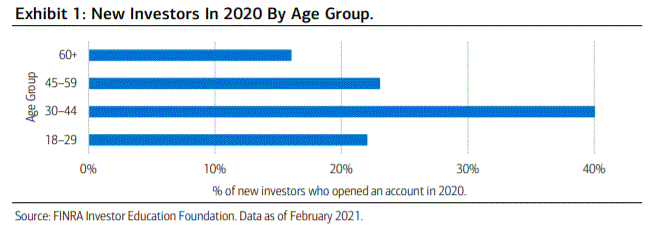
En ny aktiekultur er på vej, forudser Merrill, og den præges først og fremmest af den ynge generation i aldersgruppen 30 til 45 år, der er stormet frem som nye investorer. Det er paradoksalt nok pandemien, der har skabt den nye kultur på grund af den kraftige stigning i opsparingen i 2020 og de bedre muligheder for, at enkeltpersoner kan handle med aktier på online platforme. Merrill regner med, at den nye aktionærgruppe skaber et bull-marked i de kommende år, bl.a. fordi de nye, yngre aktører på markedet har en tendens til at blæse på kursfald. De læser heller ikke grundige aktieanalyser, men henter information på de sociale medier, der er fyldt med kortfattede rygter. Det er entusiasme, stimuleret af de store kursstigninger under pandemien, der driver de nye individuelle investorer. Selv da der var kursfald på markederne i september, lånte investorerne heftigt til aktieinvesteringer. Den nye aktiekultur begyndte i USA, men den breder sig internationalt, især til asiatiske markeder, hvor de individuelle aktionærer på nogle markeder står for hovedparten af aktiehandelen.
Uddrag fra Merrill:
An Equity Culture is Building
- and it’s a Positive for the Secular Bull Market
Equity market participation is at all-time highs, with households now owning roughly 40%
of the U.S. Equity market. - While equity ownership has been climbing for years, the unique
circumstances created by the pandemic in the form of excess savings and cash along with
spending more time indoors seem to have abetted individual investors’ engagement in the
financial markets. Generally favorable market conditions and easier and cheaper ways to
access them have further fueled the rise in interest among everyday investors. - In our view, the increased breadth of individual investors participating in Equity markets could shape
market trends moving forward and should contribute to the secular bull market for years
to come.
Strong Backdrop for Equity Ownership
We see a number of catalysts behind the recent surge in equity ownership. Of note is the
rise of online trading platforms, which studies have found tend to increase overall
participation in financial markets by attracting retail investors who otherwise would not
have participated.
Traditional barriers to entry for Equity markets have also been lowered
in recent years, amid a widespread reduction in brokerage fees and the introduction of
simple and engaging app-based trading platforms. These new methods of Equity market
access may have enticed first-time investors that found themselves flush with cash and
stuck at home amid pandemic-induced shutdowns.
The “everything rally” that kicked off last year also likely helped to draw investors in.
Driven by impressive corporate earnings and a faster-than-anticipated economic recovery,
the S&P 500 Index gained 18.4% in 2020 and is up roughly 25% year to date, with 50+
record highs reached in 2021 alone.
Even prior to the pandemic, investors had observed
outsized equity returns in recent years, likely helping to amplify enthusiasm for stocks—
the average annual return for the S&P 500 Index was 15.8% in the last five years, well
above the average annual return of 9.1% in the last 20 years.7
Individual Investors Driving Market Trends
We are starting to see signs that the new wave of individual investors is shaping several
Equity market trends. The outsized price appreciation in the so-called ‘meme’ stocks which
started earlier this year has continued with other such companies, with well-known brands
but for which share prices had suffered over the years on weakening fundamentals, have
attracted interest from these traders.
For this group of investors, fundamentals seem to
matter less than the collective enthusiasm for the company and the impulse of going
against professional investors who may be on the other side of the trade. Market
intelligence can now be gathered through social media, chat forums and stock trading
clubs which have been mushrooming all over the world.
These individual investors also appear to be undeterred by market pullbacks, having fully
embraced the dip-buyer mentality. Retail traders were among the biggest buyers during
the pandemic recovery and have continued to pour money into Equities when the
opportunity has presented itself. Case in point, they purchased a net $24.4 billion of U.S.
stocks and exchange-traded funds (ETF) in September when the S&P 500 Index pulled
back by 5%.
Investors also seem to be doubling down on their Equity market stakes, as
margin debt is hovering near record highs. As of September, investors had borrowed a
record $903 billion against their portfolios, according to data from FINRA. That figure is up
38% from one year earlier.
While so far this discussion has been limited to U.S. markets, it’s worth noting that
individual investors are also beginning to have influence overseas. They’re especially
prevalent in pockets of Asian markets—for instance, retail traders are responsible for
about 70% of the turnover in Taiwan,12 where stocks are outperforming the rest of Asia by
about 25% year-to-date.
In India, the National Stock Exchange saw retail investors’ share
grow from 33% in 2016 to 45% in 2021, with monthly registration of new investors
increasing to an all-time high of 1.5 million in June 2021.
We expect retail investor involvement to continue to grow on a global scale in years to come.
Conclusion
Our view remains that the current secular bull market began in 2013, when the S&P 500
broke out to new highs following the drawdown from the 2008 Global Financial Crisis. The
subsequent uptrend in stocks was helped by a slow recovery in economic growth and
subdued inflation but lacking conviction from individual investors, for whom the pain of the
2008 crisis was still recent.
The effect of the pandemic has been to strengthen investor
belief that given their growth and in some cases yield characteristics, Equities remain a
more attractive investment than bonds and cash in the age of rising inflation and support
from fiscal and monetary authorities. Risk tolerance has also perked up given the rise in
margin debt and attention to ‘meme’ stocks creating shallower pullbacks.
It is still unclear how a reduction in stimulus or a significant pullback in Equity markets
could influence individual investors’ engagement in the near term. But in our view, the
increased participation of retail investors should continue to add to the new equity culture
that is building out in the U.S. and internationally, and will likely continue to shape market
trends in years to come. Individual investors should continue to gain prominence as Equity
allocations continue to increase, contributing to the secular bull market.