

Resume af teksten:
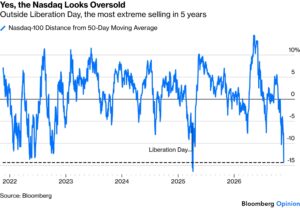
Nasdaq faldt 10 % i en volatil uge, heraf 5,3 % fredag.
S&P 500 faldt 8,6 %, mens svenske OMXSPI faldt 5,0 %.
Nasdaq-futures steg 2,3 % tidligt mandag efter ugens fald.
Teksten peger på politisk indgriben, højere reale renter og sæsonforhold som årsager til AI-salget.
Det amerikanske 10-årige obligationsrente faldt op til 11 basispoint fredag til 4,95 %.
Markederne indregner 94 % sandsynlighed for en amerikansk renteforhøjelse på 25 basispoint til 4,25 % om lidt over to uger.
FN’s Sikkerhedsråd lykkedes fredag for niende gang i træk ikke med at udpege en ny FN-generalsekretær.
44 % af de adspurgte svenskere ønsker nyvalg, mens 36 % er imod, ifølge en TV4/Novus-måling.
Fra SEB:
Global key stories
One big red warning sign – key takeaways. The Nasdaq plunged 10% during an extremely volatile week for equities, with 5.3% of the decline coming on Friday alone. The S&P 500 and Sweden’s OMXSPI ended the week down 8.6% and 5.0% , respectively. Many AI companies are trading at stretched valuations, but frankly, the potential of AI technology is extremely difficult – if not impossible – to quantify. From an economist’s perspective, there are three reasons behind the AI sell-off: (1) signs of increasing political intervention in AI , reflecting shifting power dynamics in Washington and Trump’s decision to penalise US companies seeking to build data centres abroad ; (2) rising short- and long-term real interest rates , forcing a more aggressive discounting of future earnings – i.e. lower equity valuations – while also raising funding costs; and (3) seasonal factors , as major investors seek to “close their books” and lock in strong performance figures ahead of year-end. This increases the risk of deteriorating market liquidity, potentially amplifying price swings. Analysts – and economists – now need to distinguish between AI valuations and the long-term impact of these transformative technologies on growth, inflation and productivity. Anthropic shares, which surged 17% on their market debut on Thursday, also lost ground but remain 7% above their IPO price. The US 10-year Treasury yield fell by as much as 11 basis points on Friday to 4.95%, while movements in the dollar and oil (Brent) were relatively modest. Thursday’s Thanksgiving holiday will reduce market liquidity. Early on Monday, equity markets are attempting to rebound, with Nasdaq futures currently up 2.3% (see table below for other market quotes).
A complicated world for central banks – reflections. In just over two weeks, the Fed will announce its next rate decision. At the time of writing, markets are pricing in a 94% probability of a 25-basis-point hike to 4.25%. It remains to be seen how the Fed – and other central banks – will navigate the new risk environment: high inflation and still-solid GDP prospects, now set against less supportive financial conditions (see chart below) and falling equity markets. The question is whether an equity market correction, within reasonable limits, might even be welcomed by the ECB and the Bank of Japan, both of which are also expected to raise their policy rates in December.
An extraordinary trilateral meeting with little substance – epilogue. Last week’s Xi-Putin-Trump meeting was a Russian PR success, but hardly a Yalta 2.0 – despite the Kremlin’s efforts. Trump continues, rather astonishingly, to refer to Putin as “my friend”. President Zelenskyy says: “To us, he is a murderer.” A sign of the times, reflecting the erosion of the rules-based international order and its replacement by an increasingly power-based one: on Friday, the UN Security Council failed – for the ninth consecutive time – to appoint a new UN Secretary-General. A weakened and increasingly marginalised António Guterres will leave the UN in six weeks. Conclusion: Geopolitical unpredictability must become a permanent parameter in economic forecasts. The next major geopolitical event: the G20 summit in Florida on 14–15 December , offering Trump an excellent photo opportunity on home turf. Putin has been invited, but his attendance remains unconfirmed. Notably, Europe will have a substantial presence this time – compared with Shenzhen.
Pro-EU Burnham faces a delicate political balancing act over “Breturn” – key takeaways. Friday’s new agreement confirms that the gap between London and Brussels continues to narrow. However, just over 60% of Britons still oppose rejoining the EU. The new agreement sets out a timetable for food exports and emissions trading, as well as for implementing proposals to facilitate greater mobility for young people. Prime Minister Burnham, who has already made clear his ambition to forge even closer ties with the EU, claims that the new agreement will “boost UK GDP by up to 0.5%”. Does the EU want Britain back? Political fragmentation within the EU, against the backdrop of an emerging new world order, is increasing the bloc’s interest in bringing a major global player back into the fold as that new order takes shape. This means that the UK should by no means be regarded as the weaker party in the ongoing talks between Brussels and London.
Nordic key stories
70 days without a Swedish government – some reflections. “No, but no thanks” was the Left Party’s swift and clear response to the weekend’s offer from the three red-green parties. Government negotiations (S+C+MP+V) are progressing at a snail’s pace – like a snail crawling uphill on a sand-covered slope with the handbrake on. Frustration is growing among voters. A new TV4/Novus poll shows that 44% favour a snap election, while 36% oppose it. The question now is: will the Centre Party switch sides and join the right-wing “Alliance”? Keep an eye on 27 November, the deadline for parties to submit their alternative budget proposals. This could provide an opportunity to abandon – or at least amend – the caretaker budget if an alternative proposal secures support in parliament.
Today’s key events
For graphs and analysis of the week’s most important data, click here .
CEST | Country | Event | Period | SEB forecast | Consensus | Last |
08.00 | Sweden | Housing starts | Q3 | 6.6k | — | 7.6k |
09.15 | France | PMI manufacturing | services | composite | Nov (p) | — | — | — | 49.8 | 47.5 | 48.1 | 49.5 | 46.2 | 46.6 |
09.30 | Germany | PMI manufacturing | services | composite | Nov (p) | — | — | — | 54.1 | 52.4 | 53.5 | 54.2 | 52.5 | 53.4 |
10.00 | Euro area | PMI manufacturing | services | composite | Nov (p) | — | — | — | 52.7 | 51.9 | 51.7 | 52.7 | 51.4 | 51.7 |
10.30 | UK | PMI manufacturing | services | composite | Nov (p) | — | — | — | 53.0 | 53.0 | 52.9 | 52.8 | 52.8 | 52.9 |
14.30 | US | Chicago PMI national activity index | Oct |
| — | 0.1 |
15.45 | US | PMI manufacturing | services | composite | Nov (p) | — | — | — | 54.5 | 55.7 | — | 54.9 | 56.1 | 55.9 |
Other : Germany is issuing bonds (11:30), and the US is auctioning short-term Treasury securities (17:30/19:00). The Swedish Public Employment Service publishes its weekly statistics at 12:00. Central bank speeches : ECB – Kocher/Simkus/Kocher (12:30/14:00/15:45), BOE – Pill (14:00), and Fed – Williams (22:00). The Tokyo Stock Exchange is closed for a public holiday.
Have a really great Monday and Thanksgiving week!
Market data


Kilde: SEB, https://research.sebgroup.com/macro-ficc/reports/83953
Hurtige nyheder er stadig i beta-fasen, og fejl kan derfor forekomme.