

Resume af teksten:
Inflationen i december var lavere end forventet med en stigning på 0,3% måned-til-måned for totale priser og 0,2% for kerneinflation. Faldende energipriser bidrog kraftigt til dette. Tariffer har haft en mindre indflydelse på priserne, hvor importerede varer som apparater og møbler viste prisfald, hvilket tyder på, at amerikanske detailhandlere strammer deres profitmarginer. På trods af højere priser i sektorer som bolig og medicinsk service kan faldende benzinpriser og lavere lønvækst bidrage til en fortsat lavere inflation, der nærmer sig 2% mod årets slutning. To rentesænkninger fra den amerikanske centralbank ses som sandsynlige. Beskæftigelsesvæksten er svag, og bekymringer om husholdningers overkommelighed vil spille en stor rolle i midtvejsvalgene. Arbejdernes andel af økonomisk vækst er faldet, hvilket kan føre til politiske tiltag for at afbøde kredit- og boligudgifter for forbrugerne.
Fra ING:
The December inflation data was weaker than anticipated and confirms that tariffs are not having the immediate impact on prices that most feared. The fact it is coming through so slowly gives more opportunity for falling energy costs, slowing housing rents and weaker wage growth to mitigate

Inflation for December was lower than expected with falling energy prices contributing
Inflation undershoots expectations
The December CPI report has provided another soft inflation print, with headline prices rising 0.3% month-on-month as the consensus forecast, while core inflation rose only 0.2% versus the 0.3% consensus prediction. We thought there was a strong chance of an even higher print of 0.4%, in large part due to timing issues related to the government shutdown that heightened the influence of price discounting later in November 2025 relative to a ‘normal’ November 2024. We thought this would have led to a bigger seasonally adjusted bounce for December price levels.
The key takeaway is that goods prices were very benign, which underscores the point that tariffs have had a far more muted impact on inflation than feared. Goods that are often imported and therefore subject to tariffs include appliances (-4.3% MoM), furniture (-0.4% MoM), new vehicles (0.0% MoM) and video and audio equipment (-0.4% MoM). This is a remarkable story and suggests US retailers are squeezing their profit margins. Used vehicles also fell in price (-1.1%).
Core goods prices show limited tariff impact

Source: Macrobond, ING
Door remains wide open for two interest rate cuts
In terms of sectors that continue to run hotter, the key primary rent and owners’ equivalent rent increased 0.3%, medical care services rose 0.4% and transport services increased 0.5%, largely due to a 5.2% jump in airline fares. Apparel prices increased 0.6% and food prices increased 0.7%.
This is a very good outcome overall and with Fed Chair Jerome Powell suggesting that the tariff impact hasn’t got much further to run and could peak in this current quarter, it indicates that policymakers are on course to cut interest rates further. We still see a bit of risk from tariffs, but the fact it has come through so slowly and much less forcibly than feared gives the opportunity for falling gasoline prices, slowing housing rents and weakening wage growth to contribute to CPI continuing to trend lower this year, getting very close to 2% towards the end of the year. As such, two Fed rate cuts seem perfectly achievable with the risks skewed towards a third due to the cooling jobs story.
Jobs and affordability will be key for the mid-terms
With regard to the jobs numbers, the ADP private payrolls data suggest employment increased 11,750 per week on average in the four weeks to 20 December. That’s consistent with the 50k monthly increase in non-farm payrolls, which is what the Bureau of Labor Statistics (BLS) reported last week for December. Remember though that Powell indicated that the Fed believes payrolls growth is being overestimated by around 60,000 per month, so effectively this suggests the labour market is effectively stagnant.
Household affordability concerns are set to be the key issue at the mid-term elections in November. Easing price pressures are a positive development, but it is clear from consumer confidence surveys that households are not necessarily believing it just yet. We suspect the bigger driver of anxiety is the cooling jobs market, where all sectors outside of government, leisure and hospitality and private education and healthcare services have lost jobs for seven out of the past eight months.
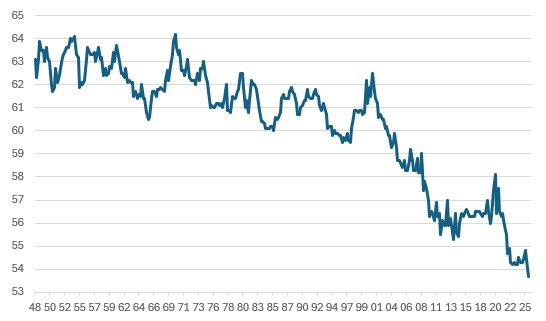
BLS calculations for % of economic output accrued to workers in the form of compensation
Source: Macrobond
On top of this, the chart above shows the BLS’s calculations for the proportion of economic growth that is accrued to workers via their pay, which has dropped from 64% in the 1950s to less than 54% today. With the corporate sector receiving an increasing share of the benefits of economic growth, this goes a long way to explain why consumer confidence is so weak relative to robust GDP prints and record-high equity markets. This suggests we could see more efforts from the Administration to generate positive headlines, including the proposed capping of credit card borrowing costs, measures to improve mortgage availability and affordability and removing some items from the scope of tariffs. It also underscores the importance to the President of being able to deliver on the proposed $2,000 tariff dividend ahead of the mid-term elections.
Hurtige nyheder er stadig i beta-fasen, og fejl kan derfor forekomme.