Resume af teksten:
Den tyske inflation er steget til sit højeste niveau i mere end to år, primært drevet af stigende oliepriser. Det nationale inflationstallet steg til 2,7% år-til-år i marts, fra 1,9% i februar, mens det europæiske mål nåede 2,8% år-til-år. Marts oplevede den største månedlige prisstigning siden 2022, med 1,2% måneds-til-måneds. Kerneinflation og servicesinflation forblev stabile på henholdsvis 2,5% og 3,2% år-til-år. Energiprisstigninger ses som den umiddelbare årsag, med knock-on effekter forventet på transport- og fødevarepriser. Markedet har indregnet potentielle renteforhøjelser fra Den Europæiske Centralbank, afhængigt af inflationsudviklingen. Yderligere reaktioner fra ECB afhænger af, om energiprisernes stigning spreder sig bredt i økonomien.
Fra ING:
Soaring energy prices have pushed German headline inflation close to 3%
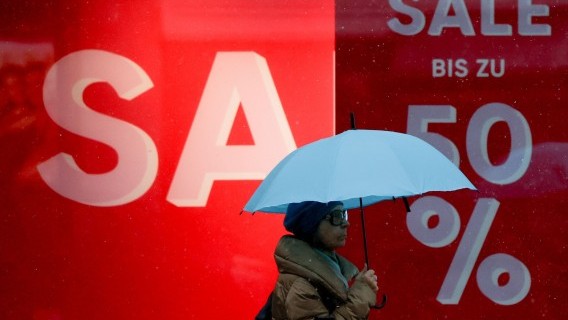
German inflation has surged to its highest level in more than two years as soaring oil prices hit consumers
This shouldn’t be a surprise to anyone. As the war in the Middle East has entered its fifth week and both energy prices and uncertainty remain high, German headline inflation reached its highest level since early 2024 in March.
While the national inflation measure came in at 2.7% year-on-year, from a still innocent 1.9% YoY in February, the European measure surged to 2.8% YoY, from 2.0% YoY. At 1.2% month-on-month, March saw the largest monthly price increase since 2022.
At the same time, however, today’s numbers also showed that for the time being, the inflation shock remains limited to energy prices as core inflation and services inflation remained unchanged at 2.5% YoY and 3.2% YoY respectively.
First inflation wave clearly on its way
Oil prices have always been the most important and direct link between geopolitical developments and the real economy. While the war in the Middle East and the blockade of the Strait of Hormuz provide further evidence of shifting geopolitics and will have longer-term implications for the European economy, the rise in energy prices is already very real. In Germany, if gasoline prices remained at their current levels until the end of the year, the loss in purchasing power for consumers would already be larger than in 2022.
Today’s inflation data shows that a first inflation wave is clearly on its way. While currently available regional data suggests that the inflation surge in March was mainly driven by energy prices, knock-on effects on transportation costs, food prices and other industrial products will follow. The only question is whether this will be a single, time-limited wave or whether it will eventually also lead to a de-anchoring of inflation expectations and higher wages. However, even if it is only ‘one’ large inflation wave, German inflation should increase further, remaining in the 3% to 4% range for most of the year.
What’s next for the ECB?
When looking at possible next steps for the European Central Bank, markets have started to price in up to four rate hikes this year. Indeed, the central bank made a hawkish pivot at the last policy meeting – but we think that markets are too much guided by an overly simplistic reading of the 2022 episode and the narrative that the ECB was far too late reacting to an oil price shock. In our view, however, there are important differences between the current situation and 2022.
Back then, the ECB was emerging from an extremely accommodative stance and normalising policy from negative interest rates and quantitative easing. With hindsight, the biggest policy mistake was probably the delayed response to an energy price shock that ultimately morphed into a broader inflation surge. Learning from that episode, though, does not mean a rate hike is imminent.
As long as the energy price shock remains broadly contained – including first‑round knock-on effects – it remains far from certain that the ECB will react at all. For rate hikes to come back to the table, the Bank would need to see a rise in inflation expectations and a broadening of inflationary pressures across the economy. So far, the war in the Middle East has instead weighed on business and consumer confidence. Meanwhile, the labour market is entering this energy shock in a weaker position than in 2022, and governments’ fiscal pockets are more constrained, making large‑scale stimulus to offset higher energy prices less likely.
Learning from the Easter Bunny
Maybe market participants can learn some lessons from the Easter Bunny. Due to surging prices for cocoa last year, chocolate Easter bunnies have seen their prices increase by up to 30% compared with 2025. A textbook pass-through of higher production costs, one could think. However, this analyst noticed that German supermarkets, at least, have already started special sales of chocolate Easter bunnies ahead of the holiday, rather than the traditional post-Easter dump sale – suggesting that overly high prices can eventually break consumer demand. Maybe that’s a first indication that household balance sheets are simply so stretched that any energy price pass-through will be much less pronounced this year than in 2022.
Three potential pain points for the ECB
Looking ahead, three potential pain points remain for the ECB: a psychological one, i.e., headline inflation above 4%, reviving uncomfortable memories of 2022; an analytical one, with core inflation above 3%, signalling broader price pressures; and a credibility one, i.e., a surge in survey‑based inflation expectations, which would constrain the ECB’s room for inaction.
Even if the latest developments in the war and in energy prices have started to shift our base case scenario more towards our adverse scenario, we find it hard to see the ECB moving at the next meeting at the end of April. By then, there will be no new forecasts, and only limited data available: March inflation, a handful of country inflation releases for April, and initial estimates of first‑quarter GDP on the day of the meeting. In all honesty, that does not look sufficient to move the needle, unless the ghosts of 2022 are really keeping policymakers awake at night.
For the June meeting, the story is different. Simply put, if we are still talking about the war in the Middle East and high energy prices by then, a rate hike is clearly possible. However, this is not our base case, as we expect the Strait of Hormuz to reopen before then.
Transitory for now but broadening of price shock could still trigger rate hike
All in all, today’s German inflation data shows that, for the time being, the new inflation wave stemming from the war in the Middle East is ‘only’ an energy price shock. Any ECB reaction to this new price shock will clearly depend on whether soaring energy prices will find their way into the rest of the economy or not. Needless to say that a broadening of inflationary pressures and a de-anchoring of inflation expectations could trigger an ECB rate hike. For now, however – at the risk of using a forbidden word, at least at the ECB – the energy price shock falls under the label of ‘transitory’.
Hurtige nyheder er stadig i beta-fasen, og fejl kan derfor forekomme.