
Resume af teksten:
Markedet påvirkes af væsentlige globale historier med fokus på geopolitik og energipriser. Olien steg markant efter angreb på saudiske tankere nær Yemens kyst, hvilket øger spændingerne i regionen. USA’s og Irans konflikter omkring Hormuzstrædet fortsætter, hvilket påvirker shippingtrafi kken. US-markederne viste en lille nedgang og venter på virksomheders interimrapporter. ECB ventes i dag at holde renten uændret på 2,25%, men åbner for en mulig forhøjelse i september grundet energiprisrisici. Trump’s midlertidige importtarif på 10% udløber snart, men nye takster forventes snart at blive annonceret. I Norden ses en fortsat svaghed i den svenske krone, som nu er undervurderet med 15% ifølge nye beregninger; dollaren tiltrækker kapital på grund af højere renter og stærk vækst i USA.
Fra SEB:
Global key stories
Headline-driven market supported by reasonable growth optimism – reflections. The conditions are currently not ideal for getting the US and Iran back to constructive talks that can secure shipping traffic through the Strait of Hormuz (see below). On Wednesday, oil (Brent) rose by another 3.4 %, to $ 94.1 per barrel, and is trading early on Thursday at $ 96.0 . The fact that the Houthi rebels reportedly attacked two Saudi tankers near the Bab el-Mandeb Strait outside Yemen has increased concerns about escalation . US stock markets closed slightly lower and were at the same time awaiting interim reports from Alphabet and Tesla that came out after the stock market closed. Both companies fell a couple of percent in after-hours trading. Next week, we get the same from Microsoft, Meta, Amazon and Apple, whose reports could either fuel AI optimism or put it to the test. Nvidia will not report until the end of August. The market’s focus remains on geopolitics and energy prices, while taking into account possible surprises from the ECB this afternoon (more below) and new announcements about US tariff policy. Overall, Interim reports have supported a reasonable growth optimism. Stock markets in Asia – as well as European and US stock market futures – are trading nervously this morning; without a compass with slightly negative undertones .
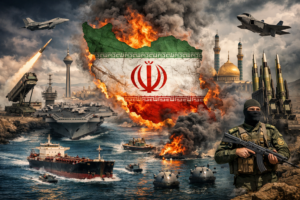
The distance to the negotiating table is growing. For the twelfth night in a row, the U.S. has been attacking targets in Iran, while Iran has continued its attacks on U.S. and other regional targets. Control of the Strait of Hormuz has become a central point of contention. Yesterday, Secretary of State Marco Rubio said that Iran cannot be allowed to control the strait and charge for passages, as it would set a “very dangerous precedent” that could spread to other parts of the world. Considering the developments in the Red Sea, there are not many who disagree with him.
The United States and Saudi Arabia in nuclear agreements . The unconventional collaboration was finalized on Wednesday evening.
Waiting period after the interest rate hike in June . The ECB’s interest rate announcement at 14:15 is expected to be undramatic. Wars in the Middle East and Ukraine – and severe extreme weather in Europe , among other places – provide short-term upside risks for higher energy and food costs . Therefore, it is both reasonable and logical that the ECB in today’s decision remains forward-leaning in its communication, i.e. remains at today’s interest rate of 2.25% but keeps the door open to be able to hike at the next ECB meeting on 10 September , when the central bank also has access to the new forecast. The policy rate of 2.25% is close to the level that can be seen to correspond to the neutral (see table below). Our forecast is that the ECB will remain at this level until the end of the year. The market has already discounted that we will have an unchanged interest rate today but that it will be raised in September. ECB President Lagarde, and the majority of the ECB, are reasonably satisfied with this expectation as they now go on vacation.
The U.S. averaged 11%. Tomorrow, Trump’s temporary import tariff of 10%, which was introduced on February 24, will expire. However, the expectation is that Trump will resort to “new tools” and that the new tariff level will land quite close to today’s average of 11%. It is still the highest level since the early 1940s. The federal government has paid back over $80 billion to companies that paid the failed tariffs. Several studies show that the majority of the cost , close to 90%, have also affected American companies and consumers.
Nordic key stories
Continued (summer) sale on the krona – conclusions. With the help of new IMF data and our own calculations, we can once again establish that the krona today is 15% “too cheap”, i.e. undervalued, against a basket of currencies. The movements of a currency can be seen as a carrier of information about how things are in a country economically, financially and politically. But the “income statement and balance sheet” for “AB Sverige” is generally strong . The explanation for the krona weakness must therefore be sought outside Sweden, especially in the strength of the dollar. Capital is drawn to the dollar due to interest rate differentials, strong productivity growth in the US, and investors’ hunt for AI exposure. However, Sweden has an important challenge , which the IMF is also shining a light on: channelling the excessively high level of financial savings , SEK 450 billion by 2025, to investments in, for example, accelerating technologies, defence and security, digital and physical infrastructure and energy transition. Today, the krona is trading at 11.06 against the euro and 9.68 against the dollar.
Kilde: SEB, https://research.sebgroup.com/macro-ficc/reports/79000
Hurtige nyheder er stadig i beta-fasen, og fejl kan derfor forekomme.