
Uddrag fra ABNamro:
Demand remains solid in the aggregate, and the labour market stays in its odd equilibrium. All eyes are on the inflation impact of the energy shock, but disinflation prospects were already limited.
The month started with a blowout labour market report, with payrolls increasing by 178k, compared to February’s revised -133k. We expect large monthly volatility to persist for some time, but the 3-month average has remained relatively stable at 68k. This is above our estimate of break-even jobs that would keep the unemployment rate steady, and indeed the unemployment rate dropped to 4.3%, although that was also partly caused by a decline in the participation rate to its lowest level since 2021.
Meanwhile, Q4 GDP got a minor downward revision to a mere 0.5% saar, although this understates the activity in the economy. Private demand rose at 1.8%, and broader measures were even more solid, especially virtually no growth in the labour force. The weak headline figure is partly caused by what the BEA estimates as a 1pp downward impact of the extended government shutdown. While we expect part of that to be reversed in Q1, incoming data – particularly on trade, but also consumption – reduces our optimism for a big rebound in Q1. Activity and the labour market are mostly business as usual, but inflation is the main story this month.
Headline CPI rose by 0.9% m/m, with a 0.7pp contribution from energy prices, which rose 10.9% m/m. Core came in at a mellow 0.2%, but the y/y rate still rose because of base effects. Surprisingly mild PPI data means our nowcast for PCE inflation for March is at 0.6% m/m, while core rises at 0.2% m/m. More generally, we expect the energy shock to transmit less strongly in PCE than in CPI inflation, but at the same time, PCE inflation was already standing at decidedly higher levels than CPI, which is unusual in a historical sense. A large part of the relatively strong disinflation of CPI compared to PCE is the shelter component, which has been a tailwind in the disinflationary process of CPI, and carries much less weight in PCE. Indeed, as of last month, shelter’s disinflation contributed 92% of the decline in headline CPI since the start of 2025. That tailwind is gone, the y/y rates have large equalized, and core CPI is now also set to rise.
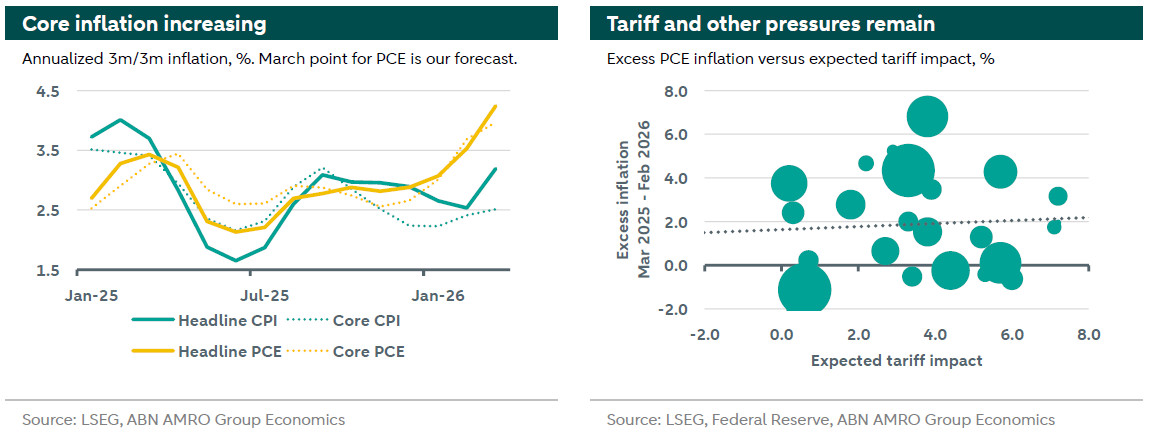
But it’s not just the energy shock: (core) PCE has been rising for a longer time. In February we saw the long tail of tariffs with high goods inflation. Evidence on tariff pass-through is mixed. A FEDS note estimates the worst is behind us, even before the tariff reversal in the Supreme Court decision. We don’t expect disinflationary pressure from the reversal. We our input-output table based micro-analysis of tariffs, and it shows that the relationship between tariff implied impact and excess goods inflation is near flat.
While the macro impact suggests cumulative excess PCE inflation is consistent with overall tariff levels, the micro evidence shows a significant amount of goods still have a long way to go, but also that not all excess inflation that we see is tariff related. For instance, prices of products that contain chips have risen much more than just tariffs would suggest, highlighting a demand channel. The instigation of comprehensive Section 301 investigations, and Treasury Secretary Bessent’s suggestion that these may be implemented as soon as the summer, shows the tariffs are still in the picture. Inflation will continue to run well above target, even if oil prices ease.
As we’ve outlined in before, we see an economy with bifurcated demand for goods, services and labour, which is likely to limit second round effects beyond the near-mechanical pass-through of the supply shocks. We still expect the Fed to look through the energy shock and keep rates on hold. By the end of the year, arguments comparable to those at the end of the last two years – downside risks to the labour market and projections of inflation returning to target – will allow the dovish Fed to resume easing. We foresee a quarterly 25bps pace to end up at 3.00% by June of next year.