Resume af Goldman analyse, bearbejdet til dansk:
Investorer frygter længerevarende energikrise
De globale finansmarkeder er igen fanget i et miljø præget af geopolitisk uro, stigende oliepriser og voksende usikkerhed om centralbankernes næste træk. Ifølge en ny markedsvurdering fra Goldman Sachs er konflikten i Mellemøsten nu ved at udvikle sig fra et midlertidigt chok til en mere strukturel risiko for verdensøkonomien.
Efter enkelte tegn på afspænding tidligere på ugen, som kortvarigt løftede markedsstemningen, har nye udmeldinger fra USA’s præsident Donald Trump igen øget usikkerheden. Dermed er investorerne tilbage i et scenarie, hvor udviklingen i energi- og råvaremarkederne i stigende grad bestemmer retningen for både renter, vækstforventninger og inflation.
Hos Goldman Sachs peger makrohandlerne Rikin Shah og Cosimo Codacci-Pisanelli på, at jo længere konflikten varer, desto større bliver risikoen for vedvarende effekter på oliepriser, forsyningskæder og global aktivitet.
Bankens basisscenarie er, at Brent-olien i fjerde kvartal 2026 vil ligge omkring 80 dollar pr. tønde, forudsat at transporten gennem Hormuzstrædet kun rammes delvist og gradvist normaliseres. I et mere negativt scenarie ventes olieprisen at stige til 100 dollar, mens et alvorligt udfald med et vedvarende bortfald på 2 millioner tønder dagligt fra Mellemøsten kan sende Brent op mod 115 dollar.
Samtidig er det ikke kun olieprisen i sig selv, der bekymrer markederne. Raffinerede produkter som især flybrændstof handles allerede til meget høje niveauer, og der spekuleres i, om selve mængden af tilgængelig energi – snarere end prisen – kan blive den egentlige begrænsning for økonomisk aktivitet. Mulige produktionsstop hos store producenter som QatarEnergy nævnes som en risiko, og begreber som “energiunderskud” og “brændstofrationering” fylder stadig mere i nyhedsstrømmen.
Især lavindkomstøkonomier med stor importafhængighed af energi, blandt andet i dele af Asien, vurderes at være særligt udsatte.
Ifølge Goldman Sachs rammer konflikten markederne gennem fire hovedkanaler: højere risikopræmie, lavere global vækst, forværrede bytteforhold og højere inflation. Indtil videre har markederne især reageret ved at prise højere inflation og større volatilitet ind, mens vækstrisikoen kun i begrænset omfang afspejles i renterne.
Det mønster er ikke usædvanligt. Historisk har olieudbudschok i første omgang ofte løftet markedsrenterne, fordi investorerne forventer en mere stram pengepolitik. Først senere – typisk efter seks til ni måneder – begynder vækstbekymringerne at dominere, hvilket kan trække renterne ned igen.
Det er netop denne forskydning, markederne nu forsøger at navigere i.
Goldman Sachs vurderer, at den amerikanske centralbank, Federal Reserve, trods markedets nervøsitet fortsat har en høj tærskel for at hæve renten. USA’s økonomi er mindre følsom over for oliepriser end i 1970’erne, arbejdsmarkedet er ved at svækkes, lønvæksten er afdæmpet, og de finansielle forhold er allerede blevet strammere siden konfliktens begyndelse.
Derfor vurderer banken, at Fed er den mindst sandsynlige blandt de store vestlige centralbanker til at svare igen med renteforhøjelser.
Billedet er anderledes i Europa. Her anses Den Europæiske Centralbank, ECB, for at være den mest sandsynlige til at hæve renten, hvis energichokket forstærkes. Ifølge Goldman Sachs skyldes det blandt andet, at ECB’s rente allerede har ligget uændret siden første halvår 2025 og befinder sig tættere på det neutrale niveau. Samtidig vurderes ECB at være mere parat til at reagere hurtigt, ikke mindst med erfaringerne fra inflationschokket i 2022 i frisk erindring.
Bank of England befinder sig ifølge analysen i en mellemposition. Den britiske centralbank har allerede renter over det neutrale niveau, og det britiske arbejdsmarked er svagere. Samtidig har centralbankchef Andrew Bailey i denne uge signaleret en mere afventende linje og understreget, at banken skal håndtere chokket på en måde, der gør mindst mulig skade på økonomisk aktivitet og beskæftigelse.
Goldman Sachs’ samlede vurdering er derfor, at sandsynligheden for renteforhøjelser er størst i euroområdet, derefter i Storbritannien og mindst i USA.
På tværs af aktivklasser er konklusionen klar: energimarkederne og udviklingen i Mellemøsten er igen blevet den vigtigste drivkraft for den globale makroøkonomi. Et enkelt tweet eller en tale fra en politisk leder kan hurtigt ændre forventningerne, og det gør ifølge banken markedet usædvanligt vanskeligt at navigere i.
Samtidig peger analysen på, at jo længere konflikten varer, desto større er risikoen for mere varige forstyrrelser i forsyningskæderne og en højere bund under flere råvarepriser. Selv hvis situationen skulle blive løst, er det langt fra sikkert, at oliepriserne vender tilbage til tidligere niveauer.
For investorerne betyder det, at fokus i første omgang fortsat vil være rettet mod inflation og energipriser. Men når olieprisen topper, kan markedet hurtigt skifte blik og begynde at prise svagere vækst og lavere renter ind.
Det er netop denne balance mellem inflationsfrygt og vækstbekymring, der nu definerer verdens finansmarkeder.
Uddrag fra Goldman Sachs:
One year on from ‘Liberation Day’, geopolitical volatility is again elevated and the driver of all markets, as US trade policy uncertainty is back at pre-Trump-Tariffs lows…
But, as the world celebrates the anniversary (sarc), Goldman’s macro traders, Rikin Shah and Cosimo Codacci-Pisanelli lay out the series of ‘what-ifs’ that represent the global macro roadmap from here…
After some signs of de-escalation mid-week which the market responded very positively to, President Trump’s speech overnight increases uncertainty again for the next few weeks. As always, the longer the conflict lasts for, the path of least resistance is higher for commodity prices. We are now getting towards the point where we can’t view the situation as just an event shock, and start recalibrating forward looking views for longer lasting impacts.
As a refresher, GIR’s baseline is for 2026Q4 Brent to realise at $80 with Hormuz flows remaining at 5% for a 6 week period before a gradual 1 month recovery, with roughly equal contributions from a larger hit to commercial oil inventories and from higher long-dated prices as the market risk-adjusts effective spare capacity. In the adverse scenario, Mideast supply recovers on reopening and Brent moderates to $100 in 2026Q4. In the severely adverse scenario with a persistent 2mb/d loss in Mideast production, Brent spikes before converging to $115 in 2026Q4.
The longer the conflict lasts, the more follow-on effects there will be. Refined products, particularly jet fuel, are trading at very high oil-equivalent prices. Another consideration is whether quantity – rather than price – proves to be the binding constraint on activity due to ‘force majeure’ at key producers (i.e. QatarEnergy) sharply reducing the flow of energy in the near term. Lower income economies with larger imported energy needs (parts of Asia) will be feeling the brunt of this.
“Energy shortages” or “fuel rationing” are being mentioned more and more.
The longer the conflict lasts for, the more lasting the impacts will be with supply chains affected. Even if there is a resolution, the distribution for where oil prices settle isn’t so clear.
There can be a higher floor across several commodity markets given destocking and infrastructure damage, and the current imbalance can create acute tightness. However, the broader market will still breathe a sigh of relief and the “deeper tail” scenarios will get priced out from the market, as we saw signs of mid-week.
News flow on potential energy rationing
This continues to be an incredibly difficult trading environment with oil/gas price distributions continually shifting on the back of evolving headlines.
MARKET IMPACTS & PRICING…
As mentioned above, the longer the disruption, the less temporary the impacts will be felt.
What are these impacts? Dom Wilson lays out four main fundamental impacts of the war:
1/ higher risk premium,
2/ drag on global growth,
3/ terms of trade and
4/ higher inflation.
In general markets have priced these impacts via higher volatility, and energy importers having seen disproportionate pressure. However, the rates market has focused much more on the inflationary impact relative to the growth drag. Historically, oil supply shocks have an ambiguous impact on broader rate levels due to offsetting growth and inflation impacts.
We can see this in our growth / policy shock decomposition model also, with the reaction to the crisis mostly seen as a large hawkish policy shock and only modest negative growth shock so far.
Average historical experience shows slightly higher policy rates in the first 1-3 months after an oil supply shock and lower policy rates 6-9 months out as growth worries weigh more heavily.
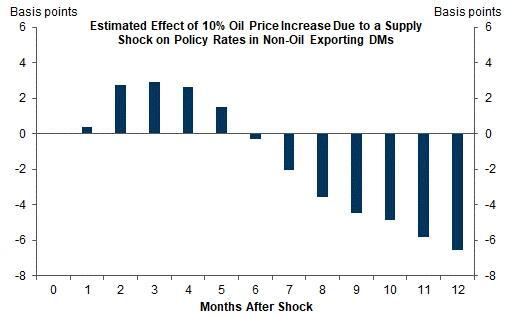
When will the rates market start pricing more of this growth impact? It may be hard to escape the dynamic of upward pressure on yields until oil prices themselves stabilize. However, we have seen more sessions recently where the correlation has been less strong between oil price moves and yields. In the 1990 oil supply shock, markets pushed yields higher, pricing a hawkish policy shock, for much of the initial phase of the oil price spike. So we have precedent for the market leaning heavily on the risk of higher rates, and demanding a sizable risk premium, even though the Fed ultimately cut rates sharply in that episode.
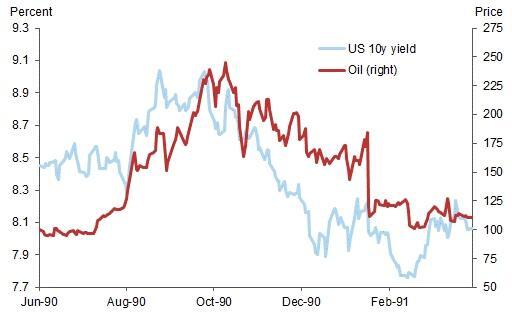
The rates market has focused more on the inflation impacts rather than the growth downside risks from the supply shock so far. CB forward guidance around their reaction functions (e.g. Europe / UK) perhaps is adding to this, having been scarred from 2022. We ultimately believe that the backdrop is different to 2022 (less fiscal impulse / room, higher starting point of rates), but this can take time to play out. Any change in fiscal stance will be key to watch.
FED LEAST LIKELY TO HIKE…
End 2026 US pricing is oscillating around small hikes or cuts priced.
Whilst distributionally we can price small hike premium given pricing in other DM countries and the added risk premium markets are pricing around the supply shock, we ultimately see a high bar for the Fed to hike this year.
The US economy is less sensitive to oil prices than in the 1970s.
Secondly, the labour market is softening (dual mandate), wage growth is already below the pace that would be consistent with 2% inflation, and inflation expectations are well anchored. An oil shock large enough to trigger concerns about persistent inflation would probably also cause significant economic damage and potentially a recession.
Thirdly, the funds rate is 50-75bp above the FOMC’s median estimate of the neutral rate, and financial conditions have tightened ~80bp since the start of the conflict which further reduces the need to tighten policy. Fed officials speeches do not show a meaningful relationship between mentions of oil price shocks and tighter monetary policy, which is very different to the ECB.
The near term beta of US rates is going to remain high to European rates and oil prices.
But front end US rates could eventually be a good growth downside hedge.
Lastly, US 5y5y inflation is interesting…
…does this add to the case about unanchored US inflation expectations.. or at these levels is it a cheap hedge against the baseline view.
ECB & BOE…
The hike distribution (as per market pricing) is open in both Europe and UK after the central bank forward guidance we have received. We believe the bar for the ECB to hike is much lower, rightly so, with the policy rate having been on hold since end H1 2025 and already at neutral. The committee seem ready to act if necessary, with a quick reaction speed (2022 is in their rear view mirror). The path to a few hikes is there should the ECB want to hike, but we do not see a sustained hiking cycle above 3% in our baseline, given the difference between now and 2022.
The market took its first step to unwind some of the risk premium priced in front end EUR rate vol this week, but the option implied payer distribution priced continues to look wide.
2w beta of daily change of selected assets (i) before conflict, (ii) 2w into the conflict, (iii) now. Bps for rates and % change for others
The beta of front end EUR and UK rates, rate vol, and EUR curve to oil is lower now than mid March.
Mix of cleaner positioning & growth risks becoming more relevant after a certain amount of hikes priced/FCI tightening?
EUR probability distribution
A series of continuous hikes will ultimately dampen forward growth.
Money market curves such as ERH7/H8 have further room to flatten if the ECB do start a series of hikes.
ERH7/H8 curve
The difference for the BoE is that policy rates are already above their neutral estimate range and the labour market is weaker.
Communication has been less clear cut but Bailey’s comments this week leaned more towards the wait and see mindset. The comment about markets “getting ahead of themselves” is similar to remarks made in an interview after the March MPC meeting. He also commented that the MPC has to deal with the shock “in a way that causes the least damage in terms of activity in the economy and in terms of jobs”. He noted that the Bank is looking at the rise in inflation expectations “very carefully” but also said that “businesses consistently say to me that they’re operating in a context of an absence of pricing power”.
Everything is a function of oil/gas prices of course, and the evolving Middle East situation at the end of the day.
But with current data/information, there is a window for the ECB to hike rates if they wanted to. We think it makes sense for the BoE to stay on hold rather than hike, but you never know with the Bank!
Unless there is a more persistent inflation shock, or a big change in the fiscal outlook, we struggle to see a large hiking cycle though and ultimately think the growth downside risks will limit the depth of hikes.
IN SUMMARY…
Energy/the Middle East situation continues to drive all macro assets.
And it just takes a tweet/speech for the macro outlook to change.. making it such a difficult trading environment.
The longer the conflict lasts, the more supply chain issues persist.
The rates market is trading the inflation shock more than the growth outlook… probably a mix of hawkish CB forward guidance from e.g. the ECB after 2022, and risk premium around the upside distribution to where commodities prices can realise.
The beta to oil with certain areas, e.g. EUR/UK front end and rate vol is starting to drop relative to mid March.. which makes sense as at some point the growth impact does need to be taken into account.
However, as seen in the past, growth risks can be more priced once oil prices peak.
Out of the G3 central banks, we would order the most to least likely to hike as the ECB, BoE and then the Fed.