


Resume af teksten:
USD/JPY har nået over 160 på grund af høje oliepriser, den japanske centralbanks tøven med rentehævning og en let stram politik fra FOMC. Japans finansminister har truet med forestående valutaintervention. Japan kan alene kun midlertidigt dæmpe USD/JPY til området 162/165 uden USA’s deltagelse. Japans sidste større intervention startede med et salg på omkring 35 mia. dollars i 2024. Spekulanter er i dag mindre short yen end i 2024, hvilket kan påvirke interventions effektivitet. USA’s finansministerium kan spille en afgørende rolle, da en fælles intervention ville være mere betydningsfuld end en ensidig japansk indsats. Hvis intervention finder sted, kan USD/JPY midlertidigt falde til 157.50, men sandsynligvis vende tilbage til 161/162, hvis oliepriserne forbliver høje. Joint intervention kunne dog have større og længerevarende indflydelse på markedet.
Fra ING:
High oil prices, the Bank of Japan’s hesitation to hike, and a slightly hawkish FOMC have all driven USD/JPY above 160 this week. Japan’s Finance Minister is threatening that FX intervention is imminent. But unless the US Treasury gets involved in joint intervention, any Japanese intervention will not depress USD/JPY for long

BoJ FX intervention in the current environment can at best put a lid on USD/JPY in the 162/165 area – but the wild card is whether the US Treasury gets involved
“Nearing time to take bold steps”
Having pushed up to a high of 160.70 in Asia, USD/JPY has fallen sharply in Europe on comments from Japan’s Finance Minister, Satsuki Katayama, that “we are nearing the time to take bold action on FX.” This is being read as signalling that intervention is imminent. Katayama also made a particular reference to watching markets while “you are on holiday” – a blunt warning to Europe not to go home short yen this long May Day weekend. The Bank of Japan has some history of intervening on market holidays.
The market is taking notice because when the BoJ does sell FX to protect the yen, it largely does so in size. Its last round of intervention to sell USD/JPY back in 2024 started with around $35bn sold in a single day. Intervention proved effective that summer (and totalled around $100bn), largely because investors were heavily short yen and Japanese authorities correctly guessed that the Federal Reserve would be cutting rates later in the year, which it did in September. For intervention to be effective, it needs to be consistent with monetary policy.
This time around, speculators are not as short yen as they were in 2024, and there is declining certainty on the path for Fed rates as global central bankers struggle to deal with this year’s energy shock.
Japanese FX intervention and USD/JPY
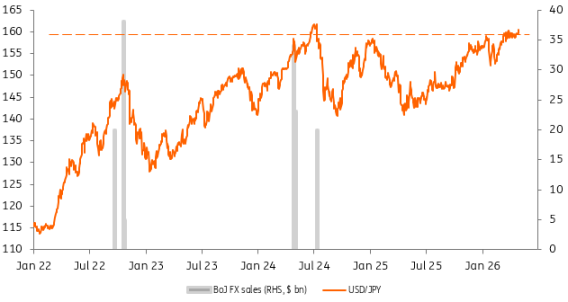
Unilateral or joint intervention will be key
Our base case would be that BoJ FX intervention in the current environment can at best put a lid on USD/JPY in the 162/165 area rather than turn the trend. Taking into account high energy prices and Japan running substantially negative real interest rates, plus the dollar being in demand, Tokyo cannot expect a sustained drop in USD/JPY.
The wild card, however, would be whether the US Treasury gets involved. Back in late January, we witnessed the very strange development of the Fed checking USD/JPY rates in late Friday New York trading – rate checks being seen as a precursor to intervention. The Fed confirmed that it was doing so as an agent of the US Treasury. The US Treasury then confirmed it had not sold any FX.
That said, joint US-Japanese intervention to sell USD/JPY would be far more significant than solely Japanese intervention. Here, not only would Washington be backing up Tokyo’s view that the yen has been unfairly targeted, but it could also develop a view that Washington felt that the dollar was too strong – perhaps linking back to some of the views expressed in Stephen Miran’s Mar-a-Lago paper .
There would also be awareness that this is a US Treasury intervention and not a Fed intervention; the latter is normally driven by systemic considerations such as disorderly FX moves adding to financial market volatility. That is not the case today.
And let’s not forget that the US Treasury intervened in FX markets last October when it bought Argentine pesos. This came alongside the US Treasury’s $20bn USD swap line granted against the Exchange Stabilisation Fund to Argentina, which Argentina tapped for $2.5bn in October and fully repaid in December.
The US Treasury rather than the Fed intervening would suggest more of an FX policy choice in Washington than a reaction to market events.
Bottom line
Threats of FX intervention this weekend have driven USD/JPY lower today. Actual intervention, if seen, could be large and, in extremis, could briefly drop USD/JPY towards the lower end of the two-month trading range at 157.50. But assuming that intervention is unilateral and oil prices stay high, we would expect USD/JPY to work its way back to the 161/162 area quite quickly, given that the fundamentals are firmly yen-negative.
Were we to see joint intervention with the US Treasury, we suspect this would raise some broader issues over dollar policy and be worth a move to the 155 area, with USD/JPY staying offered for longer.
Hurtige nyheder er stadig i beta-fasen, og fejl kan derfor forekomme.