

Uddrag fra Authers, FT:
Hypersensitive Hyperscalers
Tech companies have justified their rising capital expenditures as necessary to deliver the much-needed return on the huge investments in artificial intelligence. Productivity can’t be revolutionized without data centers. But it looks as though the hyperscalers are heeding the skeptics — both Alphabet and Microsoft reported capex notably lower than had been predicted.
But as markets grew warier about surging costs, hyperscalers’ revenues offer little reassurance. Oracle Corp. guided at its most recent earnings conference that positive free cash flows would return in 2029, providing credible evidence that markets want a balance between buildout costs and the payoff.
When Alphabet missed analysts’ sales projections, the reaction was brutal. Its sales, excluding partner payouts, were $111.2 billion for the three months that ended Sept. 30, slightly missing analysts’ projections. Its great cash-generating machine, advertising revenue, totaled $82 billion, below estimates of $83.6 billion. Shares fell as much as 10% after-hours:
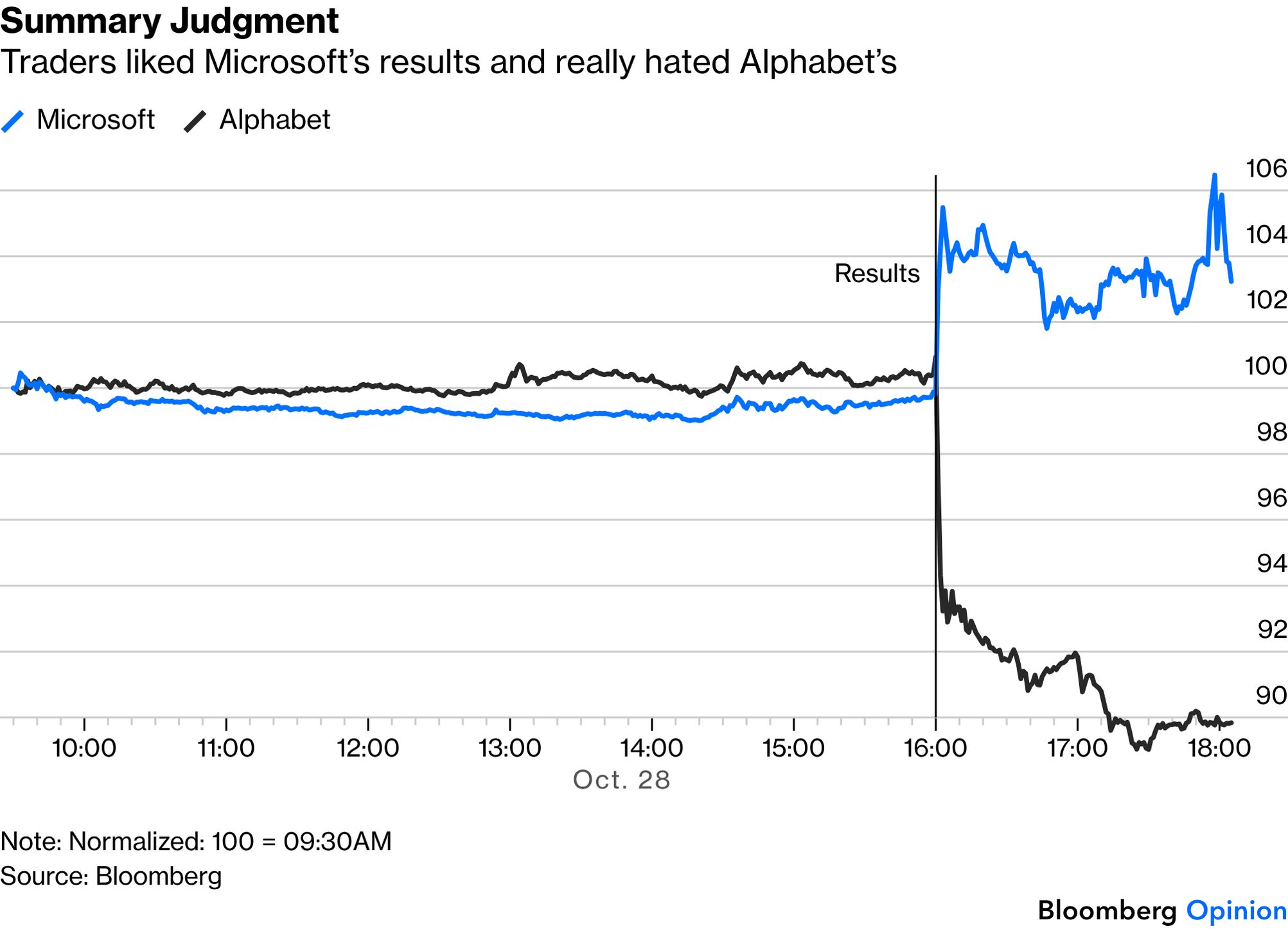
The disappointment is understandable, given growing concerns about the hundreds of billions of dollars the company has poured into AI infrastructure. Less clear is whether the selloff is an overreaction or can be justified by the underlying risks. Technology analyst Luke Lango suggests the reaction is excessive. He argues that while earnings per share at $2.12 were far below the expected $3.02 expected, much of that “miss” was an $8.66 billion paper loss on Alphabet’s stakes in other companies, largely SpaceX. This, according to him, is “accounting noise, not a broken business.”
More problematic, this was the second successive quarter of negative free cash flow. When the company’s stock sales are taken into account, it appear that shareholders are now helping to fund the AI buildout (much as is happening at Meta Platforms Inc.). The company can no longer rely solely on its own Google-driven cash generation. That’s what the market is punishing, Lango argues; this is a “how do we pay for it problem” and not a “nobody wants it” one:
Alphabet’s capex plan is intact, and the spending is about to accelerate into the fourth quarter. If you own the companies selling the picks and shovels, tonight is good news. For Alphabet stock, maybe not.
Another plausible explanation is that investors are focusing on form over substance. As Oracle’s guidance reinforces, they’re growing impatient for tech companies to start reaping returns from AI. This complicates future spending prospects, as Apex Fintech Solutions’ Mike Treacy points out. He suggests it’s only a matter of time before market pressures force companies to moderate capex. The question is whether such a pullback would delay the potential returns, or signal a deeper loss of faith in the technology:
What we’ve seen in the past is tech companies tend to move in herds, and so it will be interesting to see what the domino effect is from Oracle deciding to moderate their spending.
The contrasting response to Microsoft’s earnings showed that traders will still reward companies that can demonstrate their investments are paying off. It reported better-than-expected cloud revenue, with closely watched Azure sales growing 48% to $33.2 billion in the quarter ended in September. Overall revenue rose 19% to $92.3 billion, offering compelling evidence that Microsoft is beginning to translate its AI spending into tangible returns.
Moreover, as Lango points out, Microsoft “did it while spending less than feared: Capex was $45.2 billion against a $45.9 billion estimate. That’s the opposite of what got Meta punished last week.”
The deeper lesson from this earnings season is also growing clearer. Stock markets — and not just debt investors — are uncomfortable with the scale of the current outlays. In AI at least, we have probably passed Peak Capex.