

Resume af teksten:
Forskellen mellem franske og tyske statsobligationsrenter nåede et 15-årigt højdepunkt.
ECB-intervention i franske obligationer vurderes fortsat som usandsynlig.
Markedspresset afspejler primært Frankrigs egne finanspolitiske og politiske risici.
Der er begrænset tegn på bred smitte til andre eurolandes obligationsmarkeder.
ECB kan bruge TPI, men Frankrigs procedure for uforholdsmæssigt store underskud komplicerer adgangen.
TPI-kriterierne udelukker dog ikke automatisk en intervention.
Et stop for ECB’s balancereduktion kræver tegn på svækket pengepolitisk transmission eller uordnede markedsforhold.
ECB vurderer ikke ud fra et bestemt rentespænd, men også ud fra bevægelsens hastighed, volatilitet og smitte.
Strammere finansielle forhold kan påvirke ECB’s rentebeslutninger uden direkte obligationsopkøb.
Fra ABN-Amro:
French government bond spreads hit a 15 year high yesterday. Still, ECB intervention in French bonds remains unlikely. Current market stress does not appear to threaten monetary-policy transmission or materially tighten liquidity conditions… and spread widening largely reflects France-specific risks. Contagion remains limited, with moves elsewhere largely reflecting country-specific fundamentals. TPI eligibility complicates, but does not preclude, intervention in France, as the ECB retains discretion in applying the framework. Stopping QT would require evidence that balance-sheet runoff itself was impairing transmission or disorderly market conditions… while skewed reinvestments would require additional evidence of country-specific stress impairing monetary-policy transmission. Tighter financial conditions could influence the ECB’s broader monetary-policy deliberations even without direct intervention. Intervention depends not on a specific spread level, but on the extent of spread divergence, speed and volatility, and contagion to other markets. Market pressure supports fiscal discipline, while political demands are more likely to reinforce ECB independence.

Larissa de Barros Fritz
Senior Fixed Income Strategist

Bill Diviney
Head Macro Research / senior economist eurozone
The recent sharp increase in OAT-Bund levels is once again raising the question of potential ECB intervention. Upon presenting her ‘alternative budget’ earlier this month, Marine Le Pen also called out for ECB action “to ease the burden of interest rates”. In this note, we explore the conditions for ECB intervention and whether we think it is likely to materialise.
The ECB currently has four potential avenues it could explore for potential ECB intervention in bond markets: (1) the Transmission Protection Instrument (TPI); (2) the easing or fully stopping of its Quantitative Tightening (QT) policy; (3) the restart of flexible or skewed PEPP-style reinvestments; and (4) the creation of a new instrument.
The TPI was designed primarily as an anti-fragmentation tool, aimed at preventing “unwarranted, disorderly market dynamics” that threaten the transmission of monetary policy across the euro area, rather than country-specific fiscal or political developments. While cross-border spillovers can be one manifestation of fragmentation, they are not a necessary condition for intervention. The key question for the ECB to decide to activate the TPI is whether market pricing has become disconnected from fundamentals to an extent that threatens monetary-policy transmission. Importantly as well, TPI purchases are not subject to an ex-ante quantitative limit, with their scale instead determined by the severity of the threat to monetary-policy transmission (see here ).
However, eligibility for the TPI incorporates fiscal and macroeconomic conditionality, including that countries should be in compliance with the EU fiscal framework. This includes not being subject to the Excessive Deficit Procedure (EDP), which is currently the case for France. However, when introducing TPI, the ECB described the criteria as inputs into the Governing Council’s assessment that could be “dynamically adjusted to the unfolding risks and conditions” (see here ). An EDP therefore does not automatically exclude intervention, although it raises the hurdle, particularly if spread widening is judged to reflect French fundamentals (clearly the case now). Furthermore, we think that any willingness to intervene despite France not meeting all of the eligibility criteria would require either the government to commit beforehand to a credible fiscal adjustment, or a material rise in redenomination or broader euro-area tail risk. Current market indicators suggest that the latter remains limited (read our note on this topic here ).
The other tool at the ECB’s disposal for bond market intervention is easing or fully stopping QT . This would represent a broad balance-sheet decision, rather than a targeted support for France. EUR355bn of PSPP and PEPP public-sector holdings mature in 2027, of which we estimate that around 19% (EUR 67bn) are OATs. This is equivalent to around 20% of the medium- and long-term OATs (net of buybacks and redemptions) expected to be issued in 2027 (see here ). Full reinvestment across both programmes would therefore remove around EUR 65bn of French QT in 2027, although this would represent gross reinvestment rather than net QE. The ECB currently reinvests neither APP nor PEPP maturities.
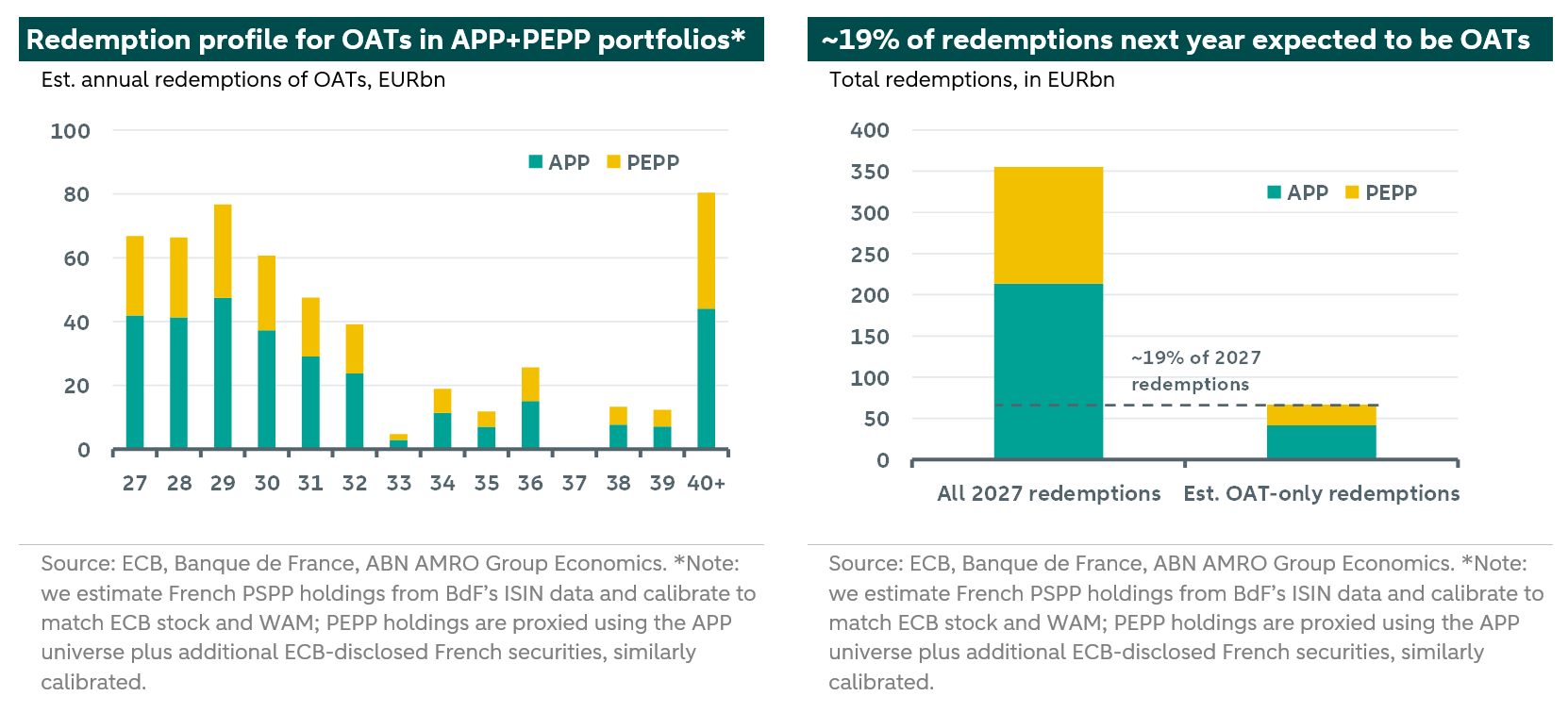
However, that would also not be a straightforward decision under the ECB’s current operational framework. The ECB explicitly mentioned in March 2024 that the stated baseline is for the asset purchase programme (APP) and the pandemic emergency purchase programme (PEPP) to be fully run off (see here ). Liquidity would subsequently be provided through refinancing operations (MROs/LTROs) and, eventually, by introducing new structural operations. Stopping QT early would therefore probably require the Governing Council to conclude that continued balance-sheet runoff itself was contributing to an inappropriate tightening in financial conditions or impairing monetary-policy transmission. That said, the framework is not binding: the Governing Council has explicitly said it “stands ready to adjust the design and parameters of the framework at an earlier stage, if necessary” (see here ), preserving room to alter the path of QT in exceptional circumstances.
A third, more targeted option would be to reintroduce flexible reinvestments and skew them towards France. This would go a step beyond simply stopping QT as the ECB would have to first reverse its decision to allow PEPP to run off and then recreate a reinvestment pool. PEPP-only reinvestment would generate around EUR 142bn of public-sector purchases in 2027 based on currently projected maturities. The Governing Council could then potentially direct a disproportionate share of that pool towards French securities, rather than simply replacing the country’s maturities (we estimate that ~18% of public-sector PEPP redemptions in 2027 are OATs). When flexibility is activated, positive net purchases in one country are offset by negative net purchases elsewhere (see here ). In practice, this means that any directed purchases of OATs would require the ECB to reinvest less in bonds maturing elsewhere, which, in turn, can put upward pressure on yields in the affected jurisdictions. However, given that the ECB is currently conducting QT, reintroducing reinvestments and skewing them towards France implies that some jurisdictions would simply experience continued run-off. A reduction in ECB demand elsewhere would only arise relative to a scenario in which reinvestments were already taking place.
Importantly, the hurdle for this second step following a halt in QT is even higher. In 2022, when such flexibility to reinvestments was first introduced, the justification was that “the pandemic left lasting vulnerabilities in the euro area economy”, which were, in turn, contributing to “an uneven transmission” of monetary-policy normalisation across jurisdictions (see here ). Based on this precedent, for flexible reinvestments to be reintroduced, the Governing Council would need to conclude that French market stress was impairing the transmission of monetary policy rather than merely reflecting a warranted repricing of French fiscal risk. Moreover, the original PEPP flexibility was explicitly framed around fragmentation “related to the pandemic”. Reintroducing it for a non-pandemic French shock would therefore likely require the Governing Council to explicitly broaden or reinterpret that framework, rather than simply reactivate the 2022 policy unchanged. This makes TPI, which was subsequently designed to address unwarranted transmission stress more generally, the cleaner existing instrument for a purely non-pandemic fragmentation episode.
Lastly, there is the possibility of the ECB to introduce a new instrument specifically tailored to the episode. The ECB’s strategy leaves room for adapting the toolkit to new shocks, including through the design of its instruments. However, a new instrument would likely be a higher-bar response than recalibrating an existing tool, as it would require the ECB to define its purpose and design rather than simply adjust an existing programme. It would also send a stronger signal that the Governing Council viewed the episode as sufficiently serious or different from previous fragmentation episodes that the existing toolkit, including TPI, was inadequate or inappropriate.
Regardless of the potential instrument used for market intervention, a key question is whether intervention is even warranted. The current situation in bond markets seems distant from indicating a disorderly and fragmented market that threatens the transmission of monetary policy and liquidity conditions. As we argued in a previous note, the recent spread widening of French bonds also reflect to a large extent country-specific fiscal and political concerns (read here ). The ECB has historically refrained from intervening in response to country-specific stress: during the 2018 Italian political crisis, for example, it did not respond to the sharp widening in Italian spreads, as the sell-off was largely seen as reflecting domestic political and fiscal risks rather than a broader threat to the euro area.
The 2018 and 2022 Italian episodes therefore illustrate the relevant distinction for France: the ECB tolerated widening associated with domestic political and fiscal risk (2018 episode), but acted when it judged sovereign stress to be impairing the transmission of monetary policy (2022 flexibility in PEPP reinvestments).
Again, current market moves remain largely confined to French government bonds and reflect to a large extend country-specific fiscal and political concerns. There has admittedly been some spread widening elsewhere, including in Belgium, Spain and Italy. However, these moves have generally been accompanied by a widening in sovereign CDS spreads, rather than a compression in the CDS-bond basis, suggesting that they have also reflected a repricing of underlying country-specific credit and fundamental risks rather than indiscriminate contagion across euro-area sovereign bonds (read here ).
Furthermore, our fragmentation indicator, which measures the extent to which euro-area government bond markets are moving together or pulling apart, has edged higher in recent months but remains close to its long-run median and well below the levels observed during past episodes of acute stress, when readings exceeded 20-40% (see right chart above). Higher readings indicate that investors are placing greater emphasis on differences between core and peripheral sovereign borrowers, signalling greater fragmentation. Current levels therefore provide little evidence of unusually elevated fragmentation or broad-based contagion across euro-area sovereign bond markets, reinforcing the view that investors do not see the current French stress as a systemic euro-area event.
The call for intervention also overlooks a crucial function of wider spreads – that such dynamics act as an important stimulus to get a grip on the deficit. Indeed, we suspect that PM Lecornu may have used deliberately cautious assumptions in his presentation of the 2027 budget (with the ‘no change’ predictions of a 6.5% 2027 budget deficit), as a political tool to put pressure on the Assembly to vote in favour of meaningful fiscal consolidation. The bond market sell-off clearly makes such politicking much more potent. Given the divided Assembly and the very painful cuts that will be necessary to get France back on a fiscally sustainable path, it will need all the market disciplining (short of a crisis) that it can get.
Just because the ECB is unlikely to intervene in French bond markets directly, does not mean that the Governing Council is completely impervious to what is going on. France is the second biggest euro area economy, and the tightening of financial conditions, heightened uncertainty and prospects for fiscal tightening are likely to weigh in the Governing Council’s monetary policy deliberations. Indeed ECB President Lagarde said as much on 28 September, even before spreads really widened: “While growth has been resilient, since our last meeting long-term interest rates have risen notably, which will slow growth and reduce pass-through by more than projected in our September exercise.” The recent bond market stress is one of the reasons we have pushed out our expectation for ECB hikes, from October and December to December and March (see here ).
In her counter budget announcement in early October, Le Pen’s call for the ECB to “to ease the burden of interest rates” would have rang alarm bells in the ears of those who value central bank independence and worry of the dangers of debt monetisation. We think it actually makes intervention even less likely, because it gives the ECB a point to prove about its independence. As we have argued previously [1], one big institutional advantage of the Eurosystem is that it is composed of 21 member states and therefore much harder for an individual politician to exert influence. Put another way, even if the entire French establishment wanted the ECB to intervene “to ease the [interest] burden,” France has but one vote on the Governing Council, and it is highly unlikely that many others on the GC could be convinced to support such a move. Bond-market intervention is arguably the area in which the ECB is most exposed to political pressure (more so than with interest rates), but an explicit demand from a national politician may nevertheless make the Governing Council more determined to demonstrate that its decisions remain independent.
While we think the bar is high for the ECB to intervene in bond markets, and we do not foresee this in our base case, it is possible to imagine risk scenarios where ECB intervention becomes more realistic. Importantly , there is no predefined spread level that would automatically trigger ECB action . The speed and volatility of the move, and the degree of contagion across sovereign markets, matter just as much.
As an illustrative exercise, we estimated how far core-periphery spreads would need to diverge for our fragmentation indicator to reach 20%, a level associated with previous episodes of ECB intervention. Core-periphery divergence would need to increase by roughly 70% from current levels. Assuming unchanged core-market conditions and recent relative periphery movements, this would correspond to spreads of roughly 300bp for France, 216bp for Italy and 124bp for Spain. This is only an illustration, as the same fragmentation reading could result from very different combinations of country moves, including greater widening in France and Italy but less in Spain, or changes in core markets themselves, for instance due to flight-to-quality flows. Moreover, 20% should not itself be interpreted as an ECB intervention threshold: the ECB could act at a lower or higher level depending on the nature of the market stress, underlying drivers and the extent monetary policy transmission is impaired. Furthermore, spread volatility has risen recently, but remains below earlier stress peaks (see right chart on the next page). As such, the speed of change and volatility in spreads would also have to significantly rise.
What if market conditions aren’t crisis-like, but still severe? ECB intervention would then likely to require that France is constructively engaged with EU institutions in some form of monitored fiscal programme. This does not have to amount to a bailout per se, although theoretically, the ESM has the firepower for such a situation. In this scenario, ECB intervention could complement an ESM bailout by calming broader bond markets and stemming contagion to other countries.
Overall, direct ECB intervention in French government bonds looks unlikely under current conditions. The widening in OAT spreads remains primarily a repricing of France-specific fiscal and political risks, with limited evidence of disorderly market dynamics, broad contagion or impaired monetary-policy transmission. Importantly, there is no specific spread level that would trigger intervention: the assessment would depend on the extent of spread divergence, the speed and volatility of the move, and the degree of contagion across sovereign markets.
If intervention would become necessary, TPI appears as the natural first choice. France’s position under the Excessive Deficit Procedure further complicates its use, but the ECB has described the eligibility criteria as only an input into its assessment, which could be “dynamically adjusted to the unfolding risks and conditions”. This leaves the Governing Council some discretion should the nature of the market stress change. Stopping QT would unnecessarily alter the treatment of the entire Eurosystem portfolio, and flexible reinvestments would also require additional policy reversal and broader justification. Creating a new instrument would seem disproportionate unless the existing anti-fragmentation toolkit proved inadequate. Market intervention could also be done via conditional ESM support through precautionary credit lines, market purchases or loans.
Still, intervention could weaken the market discipline needed to support fiscal consolidation, and political calls for action may only reinforce the Governing Council’s determination to demonstrate its independence.
[1] See Q6 in ECB Watch – A less independent Fed could mean more ECB cuts , 24 September 2025: “ Indeed, the supranational nature of the ECB arguably makes it much harder for any one politician to influence its decisions – perhaps an example where Europe’s power dispersion works to its advantage.”
Larissa de Barros Fritz
Senior Fixed Income Strategist
Bill Diviney
Head Macro Research / senior economist eurozone
Kilde: ABN-Amro, https://www.abnamro.com/research/en/our-research/ecb-rescue-for-bond-markets-remains-distant
Hurtige nyheder er stadig i beta-fasen, og fejl kan derfor forekomme.