
Uddrag fra Goldman Sachs:
Five Reasons The Bill Won’t Shrink
Goldman decomposes the $20/bbl surge into five drivers, and the punchline is that the Hormuz war premium and ship-to-ship transfers alone account for more than half:
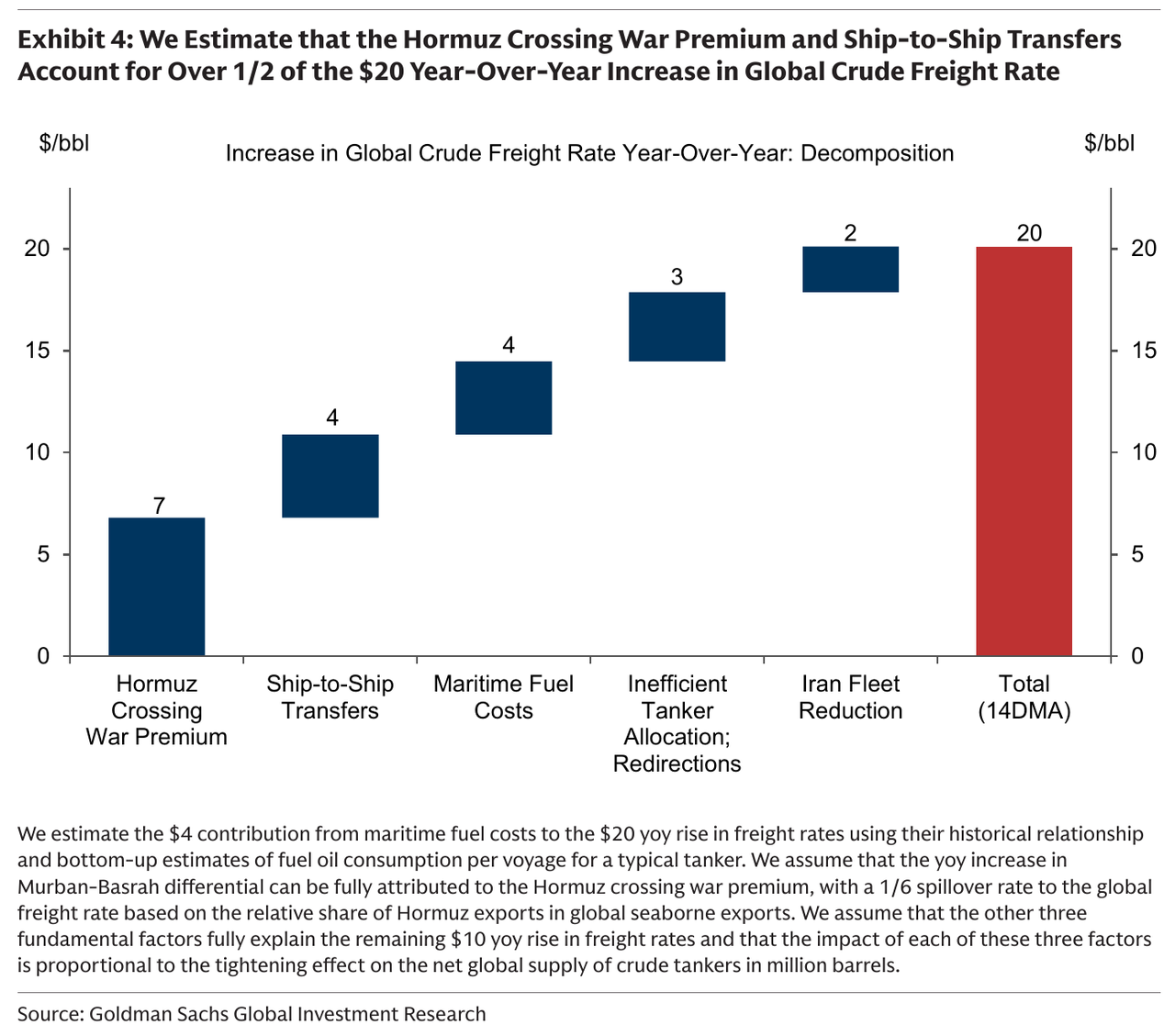
- Hormuz war risk premium ($7/bbl, or 1/3): Goldman measures it with the premium for Murban crude loaded at Fujairah (outside Hormuz) over Basrah loaded in Iraq (inside). That spread is up $35/bbl year-over-year and recently topped $40. Since roughly 1/6 of global seaborne crude still goes via Hormuz, that explains about $7 of the global increase.
- Ship-to-ship transfers ($4/bbl): roughly 1/6 of tankers operating in the Persian Gulf and Gulf of Oman are now engaged in STS transfers on any given day. Kpler reports the average round trip for a Gulf of Oman VLCC doing STS has stretched to 23 days, versus 10 days for a typical direct Hormuz run.
- Maritime fuel ($4/bbl): bunker fuel is up nearly $50/bbl, or about 70%, year-over-year.
- Inefficient tanker allocation and redirections ($3/bbl): half of all VLCCs are sailing in ballast, 4 percentage points more than a year ago, many of them idling outside the Gulf waiting for the shuttle fleet.
- The Iranian fleet blockade ($2/bbl): Iranian oil and tankers used to meet 1.7 mb/d of Asian demand, and that demand has shifted to non-sanctioned ships.
The first chart is the one to watch. Here is how Goldman’s Hormuz premium (Murban minus Basrah) tracks Gulf-to-China freight:
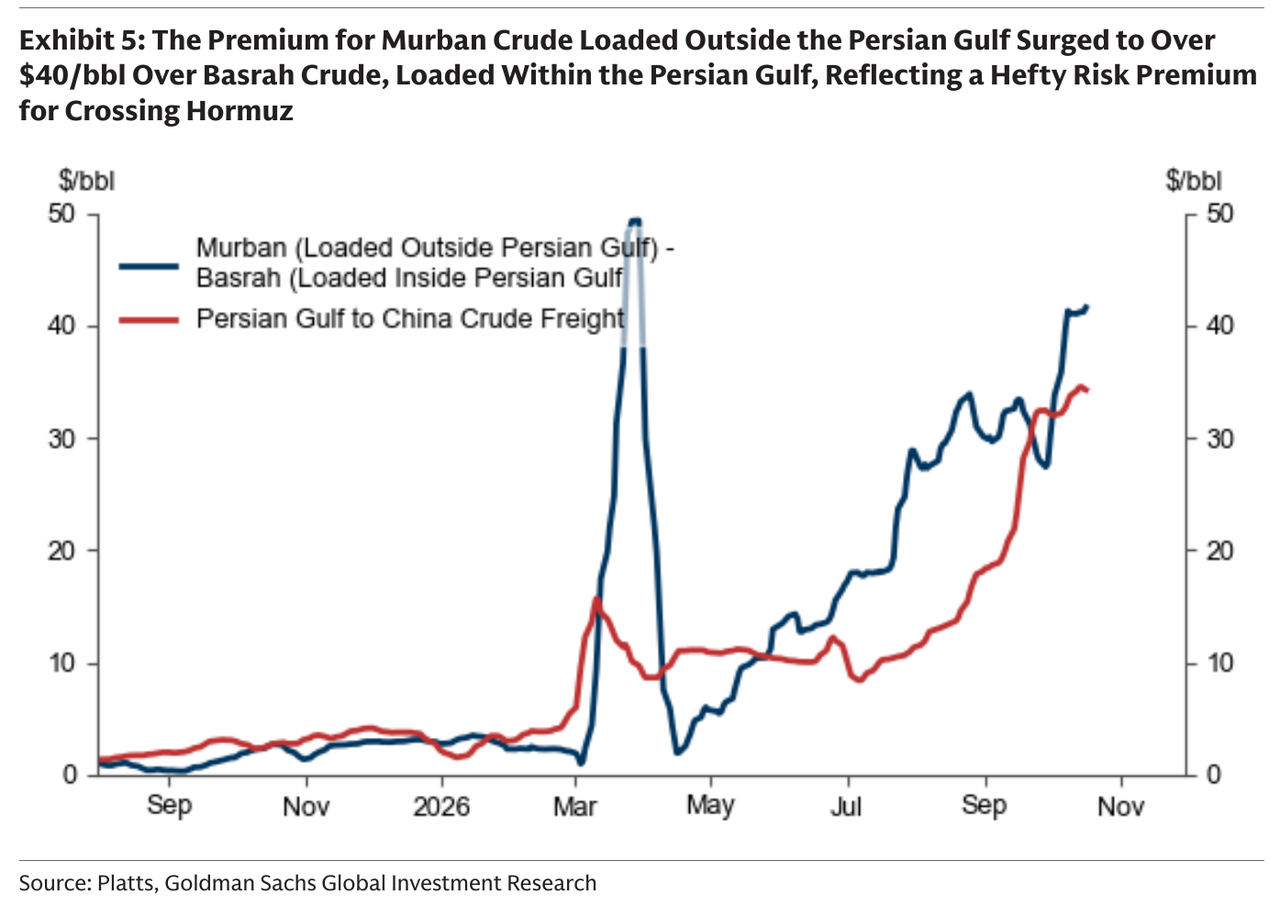
The second explains the paradox at the heart of this week’s headlines. In Goldman’s words:
“A recovery in Persian Gulf crude exports can ease crude prices, but it lifts freight rates when ship-to-ship transfers are driving the export increase.”
Translation: the record Gulf flows and the record freight bill are the same story. Every extra barrel shuttled out to the Gulf of Oman ties up a supertanker for more than twice as long as a normal Hormuz round trip:
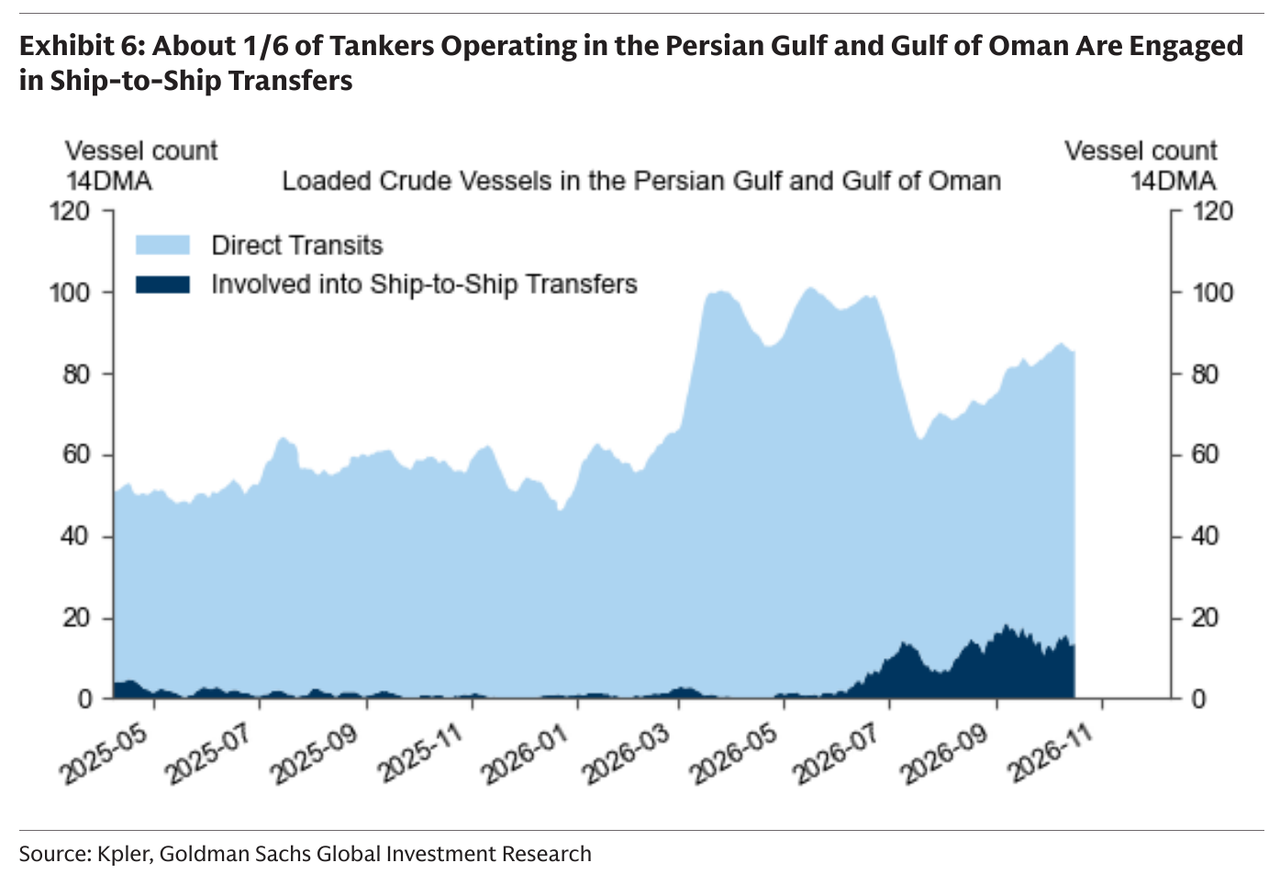
Some math: at today’s ~$800K a day, a 2-million-barrel VLCC costs about 40 cents per barrel per day at sea. Add 13 extra days for the STS dance and that’s about $5/bbl before the cargo even leaves the Gulf of Oman. Somewhere, a tanker owner is smiling.
Who Pays: Distant Producers, Asian Refiners… And You
Because Brent, Dubai and most other benchmarks are priced free-on-board, the freight bill doesn’t show up in headline crude prices. It shows up in the differentials, and in refining margins.
On the producer side, Goldman notes that Middle Eastern producers sell nearly half their crude on long-haul routes, mostly to Far East Asia, and “exceptionally high freight rates on Middle Eastern routes are pushing producers to discount their crude sharply,” especially grades shipped from inside the Gulf (Iraqi Basrah, UAE Upper Zakum, Qatari Al Shaheen). Same story in the US, where high freight to Northwest Europe blew the Brent-WTI spread out to $14/bbl last week versus the usual $5. Last week we showed how the same freight shock has left heavy crude stranded in the Americas, with Canadian, Colombian and Ecuadorian grades down roughly $10/bbl. The winners are the producers closest to their customers: Brent in Northwestern Europe and Russia’s ESPO.
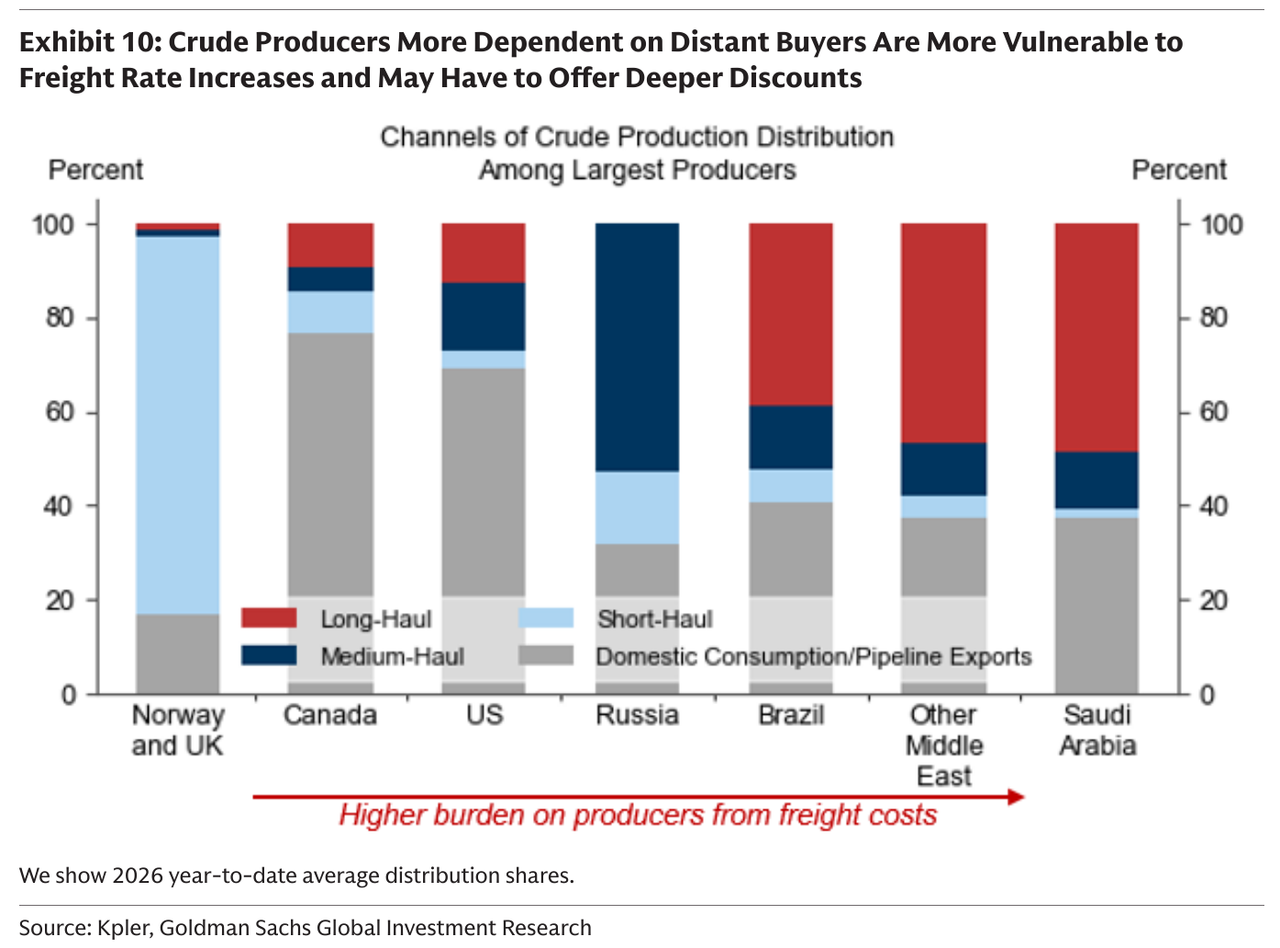
On the consumer side, the most exposed are Asian refiners: China imports 50% of its crude via long-haul routes, and the rest of Asia 80%. They can either pass the freight on to consumers (harder in China, where EVs are now over 60% of new car sales, or in places like South Korea, where retail fuel prices are capped) or eat it. And here is Goldman’s warning: while gross refining margins remain very high, net margins, after freight, energy and operating costs, are already falling, European refiners have cut runs over the past two weeks, and Asian margins “are likely approaching levels at which further freight rate increases would be difficult to absorb“:
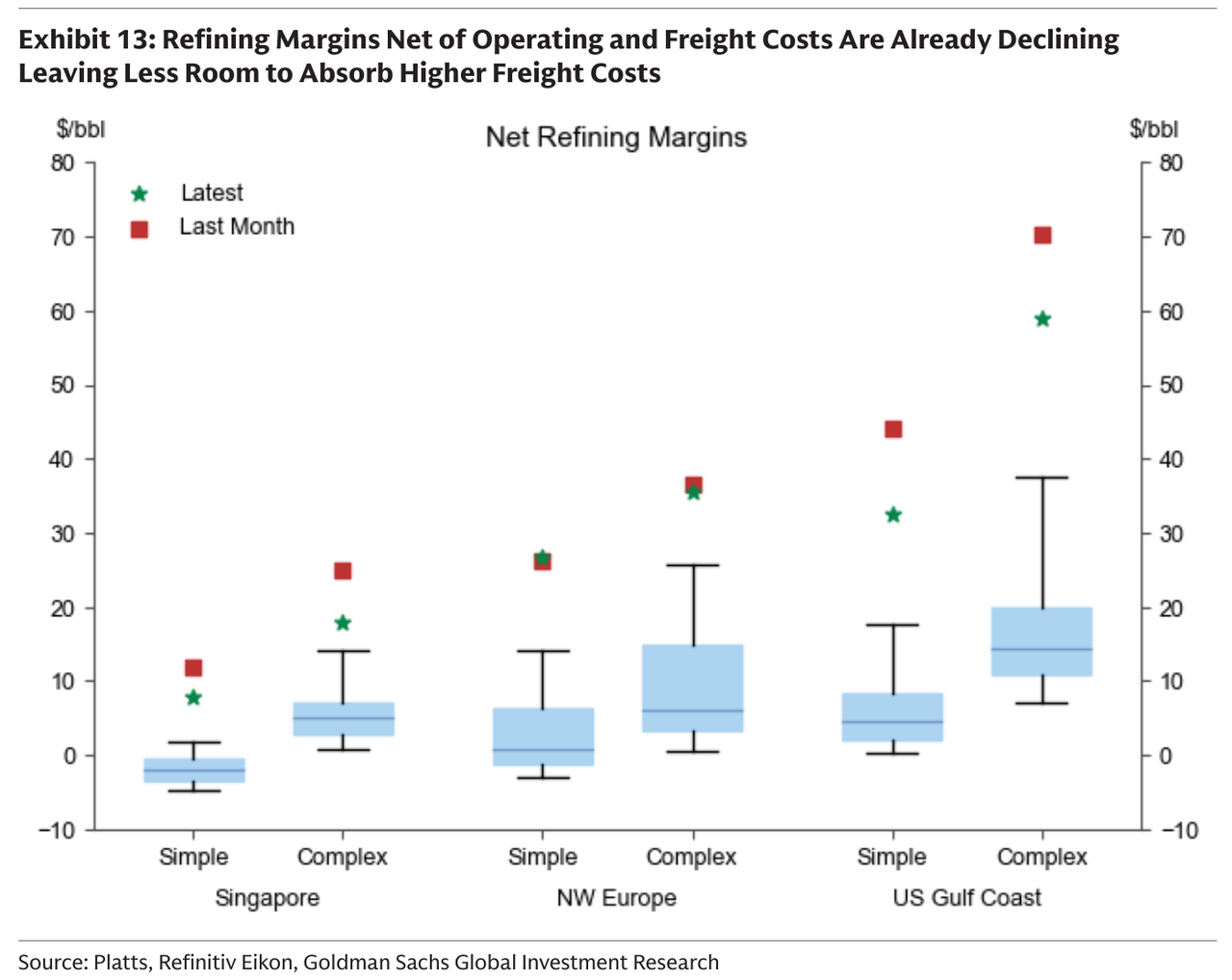
That matters because, as we noted in our freight cascade post, the refining margin is the ceiling on freight. Squeeze it far enough and refiners cut runs, which means less product in a world already short on diesel. Just this morning, the EIA reported distillate stocks at seasonal record lows. In Goldman’s own words, lower net margins “threaten refined product output and could raise global refined product prices.” The tanker owners get paid either way.
The War Premium Has Moved To The Water
The market got the reminder on Wednesday. Brent jumped more than $2 to $110.85 after Iran’s President Pezeshkian said the US could not expect dialogue while blockading and threatening Iran, which leaves the benchmark near five-month highs. Kpler counted at least 18 vessel attacks over the past two weeks alone.
Goldman still sees Brent falling to $90 by year-end and averaging $80 in 2027. But even that baseline, the bank admits, “would require continuing ship-to-ship transfers without reliable freedom of navigation through the Strait,” a US blockade that “appears unlikely to be lifted without a peace deal,” and occasional attacks that “are likely to keep the Hormuz war risk premium elevated.” Goldman’s conclusion:
“Overall, we expect the five drivers supporting crude freight rates to persist largely as long as the Middle Eastern conflict remains in its current state… Higher freight rates for longer pose some upside risk to our Brent forecast, along with the risks of more intense shipping attacks, damage to oil infrastructure, and a stickier geopolitical risk premium.”
We would go further. The headline flow numbers say the supply shock is over. The freight numbers say it has simply moved: out of the FOB price and into shipping, differentials and refining margins, where it is harder to see and just as expensive. And with Iran now hitting tankers in the Gulf of Oman, the very place where the shuttle system hands off its cargo, the “resilient” flows are probably more fragile than a 24.6 million b/d headline suggests. Our bet is on freight staying higher for longer, and Goldman’s $90 year-end Brent looking optimistic.
Then again, in shipping (as in everything else) nothing cures record rates like record rates. That cure just requires a peace deal that nobody in Tehran is in any rush to sign.