
Resume af analyse fra Deutsche Bank
Der er opstået en usædvanlig og potentielt farlig kløft mellem obligationsmarkedet og aktiemarkedet. Mens obligationsinvestorerne i stigende grad indregner risikoen for en ny gælds- og inflationskrise, fortsætter aktiekurserne tæt på historiske rekorder. Ifølge Deutsche Banks analytikere kan denne modsætning næppe fortsætte. Enten skal den finansielle uro hurtigt aftage, eller også står aktiemarkederne foran en betydelig korrektion.
Det mest opsigtsvækkende faresignal kommer fra de europæiske statsobligationer. På blot én uge er renteforskellen mellem franske og tyske tiårige statsobligationer udvidet med hele 32 basispoint – den største ugentlige udvidelse i Bloombergs tilgængelige historik tilbage til Tysklands genforening i 1990. Også italienske statsobligationer er kommet under pres med en udvidelse af rentespændet til Tyskland på 23 basispoint.
Bevægelserne minder om de finansielle stressperioder under den europæiske gældskrise i 2011-2012, coronakrisen i 2020 og inflations- og rentekrisen i 2022. Dengang blev uroen på obligationsmarkederne ledsaget af markante aktiekursfald.
Denne gang har aktiemarkedet imidlertid næsten ikke reageret. Det europæiske STOXX 600-indeks ligger blot fire procent under sin rekord, mens det amerikanske S&P 500-indeks befinder sig inden for én procent af sin historiske top. Samtidig er risikopræmierne på europæiske virksomhedsobligationer fortsat overraskende lave.
Analytikernes centrale pointe er, at obligationsmarkedet allerede priser konsekvenserne af voksende finansiel uro ind, mens aktiemarkedet tilsyneladende regner med, at virksomhedernes indtjening og den økonomiske vækst stort set kan fortsætte uforstyrret.
En anden alvorlig fejlvurdering kan ligge i forventningerne til centralbankerne. Investorerne har i kølvandet på den seneste uro nedjusteret forventningerne til yderligere renteforhøjelser fra blandt andre Federal Reserve og ECB. Men med inflationen fortsat over centralbankernes målsætninger er mulighederne for at komme finansmarkederne til undsætning begrænsede.
Deutsche Bank fremhæver, at investorerne gentagne gange begik samme fejl under inflationskrisen i 2022-2023. Hver gang finansiel uro fik markedet til at forvente en mere lempelig pengepolitik, blev forventningerne efterfølgende gjort til skamme, fordi inflationen tvang centralbankerne til at fortsætte stramningerne.
En tredje potentiel fejlvurdering gælder oliepriserne. Trods mere end seks måneders konflikt mellem USA og Iran og vedvarende begrænsninger i Hormuzstrædet forventer oliemarkedet fortsat betydelige prisfald. Mens den nærmeste Brent-future i analysen handles omkring 102 dollar pr. tønde, ligger prisen for levering om seks måneder på 90 dollar og om tolv måneder på 83 dollar.
Markedet har imidlertid gennem længere tid konsekvent undervurderet konfliktens varighed. Hvis oliepriserne fortsætter på et højt niveau, risikerer de første direkte inflationsvirkninger at sprede sig til resten af økonomien gennem højere produktionsomkostninger, lønninger og priser på varer og tjenesteydelser.
Det kan betyde, at centralbankerne bliver nødt til at fastholde en stram pengepolitik, netop som højere renter og voksende finansiel usikkerhed begynder at bremse væksten.
Dermed tegner der sig et særligt ubehageligt scenarie for aktieinvestorerne: Stigende inflationspres, højere finansieringsomkostninger og svagere økonomisk vækst kan ramme virksomhedernes indtjening samtidig med, at centralbankerne er afskåret fra at sænke renterne.
Deutsche Bank understreger dog, at en større aktiekorrektion ikke er uundgåelig. Hvis den finansielle uro hurtigt aftager, som efter Silicon Valley Banks kollaps i marts 2023, kan aktiemarkedet undgå en bredere nedtur.
Men fortsætter presset på statsobligationer, renter og energipriser, peger erfaringerne fra tidligere kriser på, at aktiemarkedets reaktion blot er forsinket. Analytikerne minder om, at aktiekurserne også fortsatte deres optur i slutningen af 2021, selv om inflationen var eksploderet, og centralbankerne var begyndt at signalere stramninger. Først i januar 2022 toppede aktiemarkederne, hvorefter en længere nedtur fulgte.
Den afgørende konklusion er, at aktiemarkedet endnu ikke har taget konsekvensen af de advarselssignaler, som obligationsmarkedet sender. Hvis den finansielle uro begynder at ramme den økonomiske vækst, kan investorerne blive tvunget til en brat revurdering af aktiernes værdiansættelse.
Uddrag fra Deutsche BAnk:
we are left with this divide across asset classes, with bonds pricing a fundamentally different macro regime from equities. In essence, we’re pricing the symptoms of a new regime (e.g. yields at multi-decade highs and wider sovereign bond spreads), without pricing the logical consequences (e.g. lower growth and higher default risk) which have previously manifested in weakness for risk assets.
This dislocation is unlikely to persist.
Unless the financial stress of the last week starts to ease rapidly (a bit like happened in the aftermath of SVB’s collapse in March 2023), then risk assets will come under mounting pressure.
So, with all that in mind, below are some of the biggest market dislocations that Allen and his team are seeing right now
1. Last week brought clear signs of contagion in Europe, with French and Italian sovereign bond spreads widening significantly. Yet risk assets in aggregate saw little reaction, with the STOXX 600 still only 4% beneath its record high. This is completely different to what happened in other periods of sovereign stress.
The moves in sovereign bond spreads last week were reminiscent of crisis periods. Last week, the Franco-German 10yr spread widened 32bps, the most in available Bloomberg data back to German reunification in 1990. Similarly in Italy, the spread over 10yr bunds widened 23bps last week.
In previous moments of contagion fears like this, it’s gone hand-in-hand with a sharp correction in risk assets. That happened in the European sovereign crisis in 2011-12. It happened again in the turbulence of the pandemic in March 2020. And it also happened in 2022, when rate hikes and a growth slowdown saw the STOXX 600 enter a bear market.
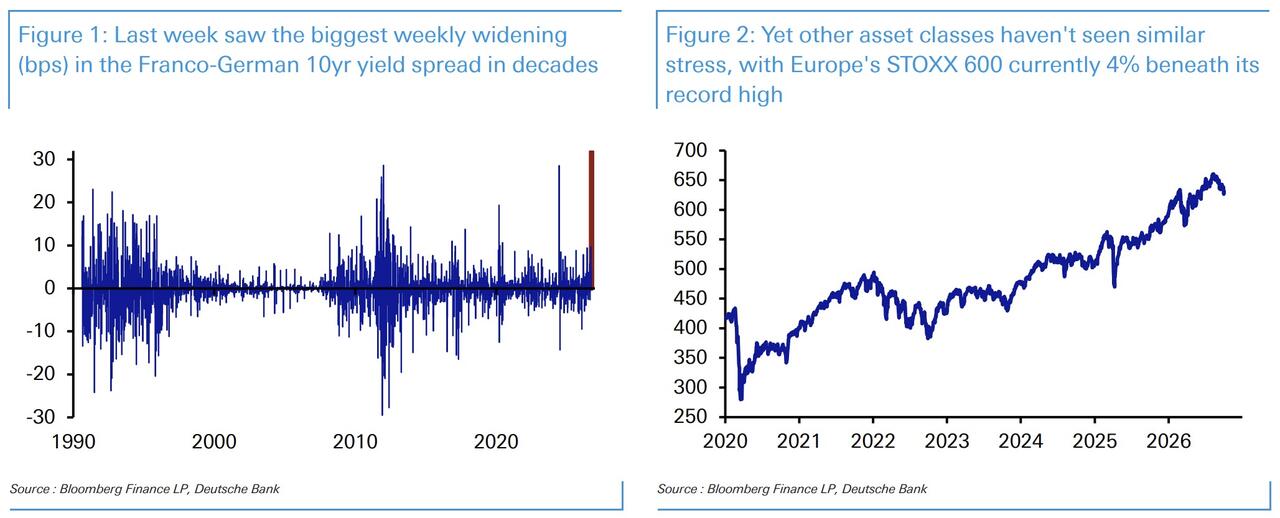
But this time around, despite the widest Franco-German 10yr spread since 2012, and the biggest weekly widening in decades, equities have barely budged. The STOXX 600 is within 4% of its highs, and the index “only” fell -1.1% last week. Those moves are not consistent with the scale of the spread widening. Elsewhere, Euro IG spreads have been remarkably calm, only rising to 101bps by Friday. That is far beneath their levels during the other periods of stress mentioned above, such as 2011-12, 2020, and 2022.
This simultaneous situation of sharply widening sovereign spreads, but limited equity declines and limited widening for corporate credit is highly unusual. In essence, we have rates markets pricing contagion and a significant hit to growth, which isn’t being reflected in other asset classes.
2. Last week’s financial stress saw markets price out the chance of rate hikes. But inflation is still above target, and markets risk over-weighting how dovish central banks can be. In fact, we saw this repeatedly in 2022-23, when several moments of financial stress led to dovish repricings, which were each unwound given above-target inflation.
Given last week’s contagion fears and the tightening in financial conditions, investors priced out the chance of future rate hikes from the big central banks like the Fed and the ECB. That applied to the next decision in October, as well as the rate path further out.
However, because inflation is above target, there’s inherently a limit to how dovish central banks can become. That’s unlike the 2010s, when belowtarget inflation gave central banks the space to make dovish pivots in response to financial stress, as the Fed did in early 2016, and again in late2018.
Instead, the backdrop is closer to the last inflation wave in 2022-23. Back then, there were several moments of stress that led to a clear dovish repricing:
- It happened initially after Russia’s invasion of Ukraine in early 2022, when growth fears initially outweighed the inflation ones.
- It happened again in September/October 2022 at the height of the equity bear market, around the time of the UK mini-budget and the associated market turmoil.
- It also happened around SVB’s collapse in March 2023, when fears of financial contagion led to questions about whether the economy could weather more hikes.
Nevertheless, each time the underlying problem of above-target inflation reasserted itself, forcing central banks to keep hiking, and that risk is being neglected again today. Indeed, for all that real yields have risen, broader financial conditions haven’t reacted too much by historic standards.
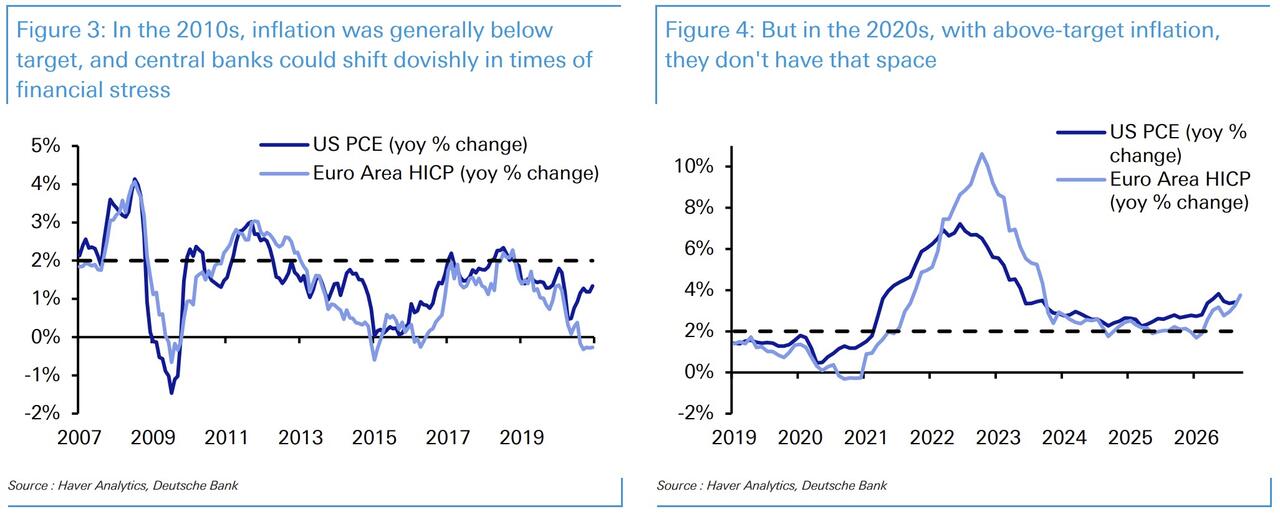
On top of that, we also know central bankers tend to overcorrect for the last crisis. We’re already seeing a more hawkish reaction function today given many were criticised for underestimating inflation back in 2021-22. n Ultimately, the problem is, so long as headline and core inflation remain above target, it’s difficult for central banks with an inflation mandate to ride to the rescue every time we see financial stress.
3. The oil futures curve still implies a normalisation in oil prices, despite being consistently wrong for over six months now. Markets keep pricing a breakthrough that hasn’t arrived.
When the US-Iran conflict began, the oil futures curve became heavily backwardated, or downward-sloping. People expected the conflict to be temporary, and therefore oil prices would be lower in the months ahead if the Strait of Hormuz reopened.
Initially, it looked like those hopes would be realised, as oil prices fell significantly in June when the interim deal was agreed between the US and Iran. But, when the re-escalation occurred from July onwards, the curve became backwardated again, which has persisted since.
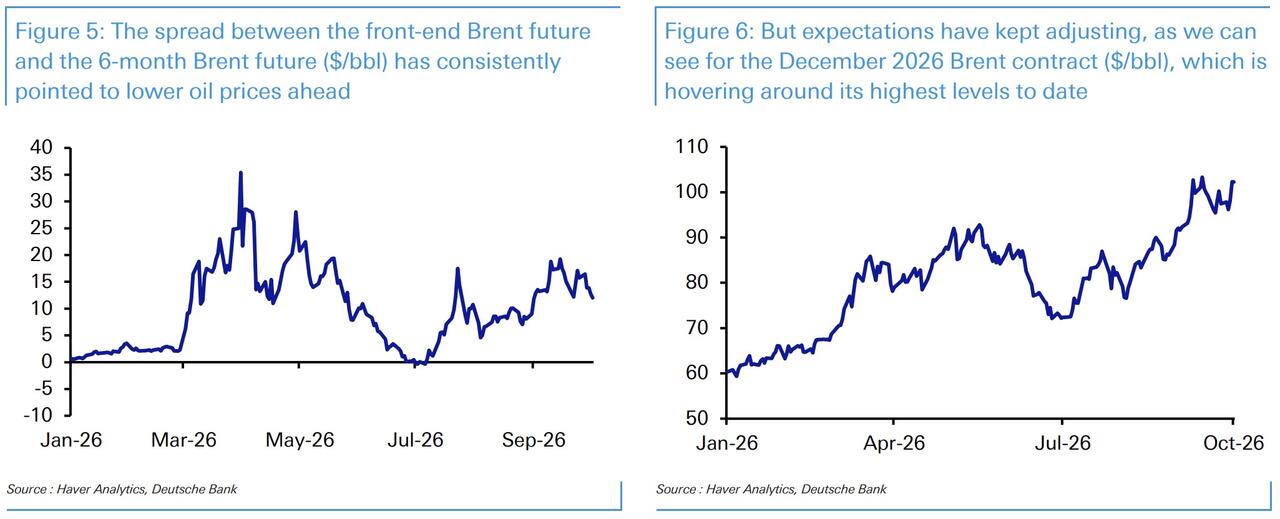
Yet, even though the conflict has lasted over 6 months now, people still expect oil prices to see a significant decline in another six months’ time. At time of writing, the front-end Brent future is at $102/bbl, the 6-month future is at $90/bbl, the 12-month future is at $83/bbl.
So, despite being consistently wrong on this, markets are still pricing in lower oil prices ahead. But, because the conflict has continued, oil prices have persistently had to catch up. We can see this by looking at the current front-end future for December 2026, which is now hovering around its highest levels to date.
4. On a connected note, recent months have seen continued supply shocks. Yet markets are only pricing the first-round inflation shock, rather than the secondround consequences as well.
This year has brought extensive supply disruption, most notably with the closure of the Strait of Hormuz. Collectively, that’s driven up energy and food prices, whilst the ongoing El Nino risks further exacerbating that. This is the obvious first-round effect.
But, with the Strait of Hormuz still restricted over six months on, it’s increasingly tough to call this a temporary shock. Indeed, Brent crude oil prices remain above $100/bbl, and broader commodity prices have risen significantly.
- First, it isn’t obvious how a dramatic oil price decline happens in the next few months. If anything, recent reports have suggested an escalation is still possible, with the WSJ reporting that President Trump expects to resume bombing after the mid-terms, and Bloomberg (among others) reported that the US was sending an additional aircraft carrier, along with 10,000 sailors and Marines to the Persian Gulf.
- Second, we know from history that many of these supply-side shocks can linger. For instance, after the 1973 oil crisis, prices nearly quadrupled, but remained at that level in real terms for years afterwards, and didn’t fall back to the starting level.
- Third, we saw in the last inflation wave of 2021-22 how energy inflation can spread into core items, particularly when it lingers more than a few months. After all, every industry uses energy, and those higher costs can get passed on into other goods and services.
- Fourth, the monetary tightening to bring down inflation has only just begun, and occurs with a lag that peaks after 12 months. We are some way from that point yet.
- Fifth, when inflation has already been above target for a period, if another supply shock were to happen, there are heightened risks that it unanchors inflation expectations, because inflation has already been high for an extended period.
For now, markets still expect oil prices and broader inflation to come down in the months ahead. In other words, they’re pricing that second-round effects are unlikely to persist. However, the experience of recent months and past supply shocks suggests that the risks lean in the other direction.
5. The broader point is the bond market has now started to price in a world of mounting financial stress, but equities remain sanguine. Increasingly, they’re pricing two fundamentally different worlds.
Over the last month, we’ve seen bond markets price in more inflation risk, more fiscal risk, and the risk of more restrictive policy rates. That’s pushed yields up to multi-year highs around the world. But equities have generally brushed this off, with the S&P 500 closing within 1% of its record high last Friday, whilst the STOXX 600 remains within 4% of its record high this morning.
Clearly, it’s possible for yields and equities to rise together when growth remains strong. However, last week demonstrated that this is not simply a “high growth” story. In fact, sovereign spreads are now widening significantly, credit is coming under stress, oil prices remain high, and investors are actively questioning if the economy can cope with further rate hikes.
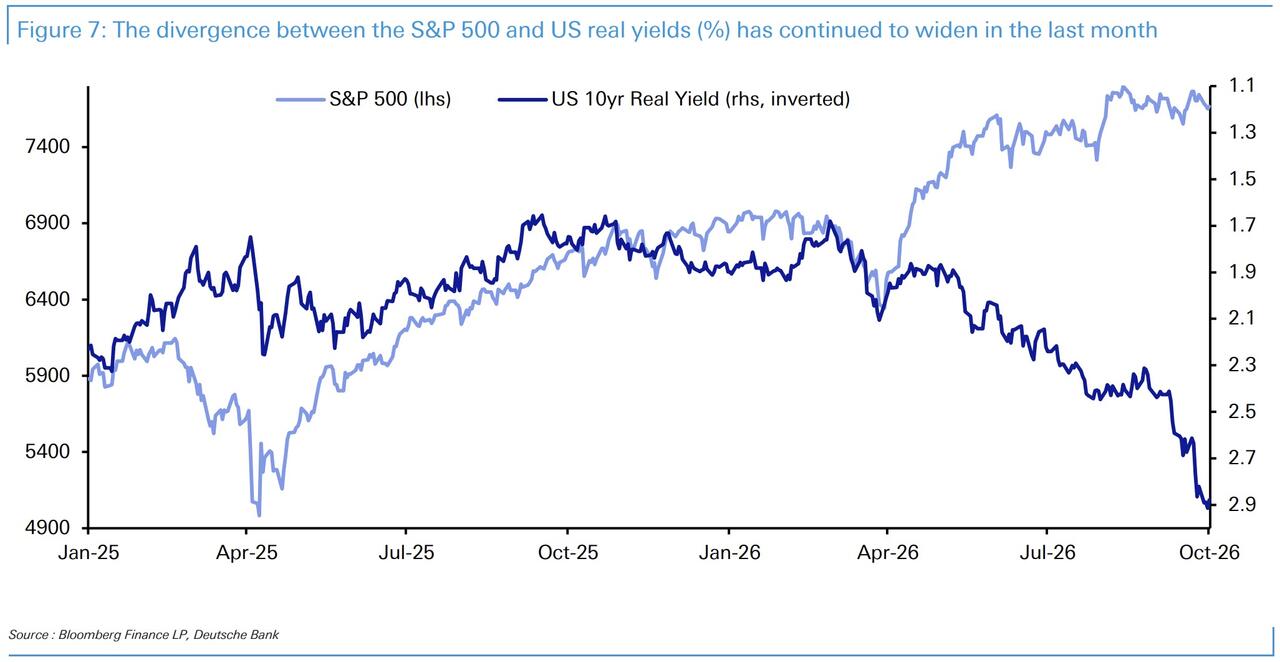
The problem is that when this kind of financial stress has persisted, be that in the sovereign crisis in 2011, or the pandemic turmoil of early 2020, or in the rapid rate hikes of 2022, risk assets can’t shrug that off indefinitely. In all those cases, there were ultimately significant equity declines in the affected markets. Unless the broader financial stress disappears quickly (as happened after SVB’s collapse in March 2023), then risk assets will come under mounting pressure.
Conclusion: Bonds and equities are pricing different regimes, but the ultimate resolution will be decided by whether this financial stress begins to slow the economy.
The last week has seen clear signs of financial market stress:
- Sovereign bond spreads have widened as investors become more worried about fiscal risks.
- The prospect of faster rate hikes has pushed front-end yields higher around the world.
- Longer-dated oil futures keep rising, as investors price a longer closure of the Strait of Hormuz and extended disruption to oil markets.
Because of all this, bond markets are starting to recognise that the collection of shocks we’re seeing are unlikely to prove temporary.
This pattern has echoes of what we saw in the European sovereign crisis of 2011, the initial pandemic turmoil of March 2020, and the rapid rate-hiking cycle of 2022. In each case, there were clear signs of financial stress. Moreover, growth also took a hit, either via an outright recession or a significant slowdown. That backdrop meant that equities and other risk assets came under pressure as well.
But today, we haven’t seen the financial stress cause wider growth spillovers so far. After all, it’s only just begun, and until recently it was plausible to argue that higher yields were also driven by strong growth. However, last week’s market moves demonstrated that this is no longer simply a “strong growth” story.
For now, equities have been remarkably unfazed. And we know from the previous episodes above that the equity reaction can be delayed. For instance, in late-2021, even as central banks began to turn more hawkish and inflation was far above target, the S&P 500 and the STOXX 600 kept rising, and only peaked in January 2022. So there has been a lag before.
For now, there are still hopes that this disruption will prove temporary, whether that’s from fiscal risks, tighter central bank policy, or the inflation risk from oil. Indeed, previous moments of stress in recent years, like March 2023 around SVB’s collapse, ultimately passed quickly and did not cause a broader correction for risk assets.
Nevertheless, it’s getting harder to justify these two realities at once. If the financial stress above continues, all the recent precedents suggest that risk assets will eventually come under mounting pressure, even if it happens with a lag.